Guides · Sneakers
How to Tell if Your Air Jordans Are Real or Fake (2026)
The Air Jordan 1 is one of the most counterfeited sneakers on the planet, and replicas keep getting sharper. But most fakes trip over the same details: the Wings stamp, the ankle collar, the heel silhouette, and the Swoosh. One caveat up front, because without it this guide is easy to misread: the tells below describe the Air Jordan 1 specifically. The 3, 4, 5, 6 and 11 are built differently, and half of these details do not exist on them at all – a genuine 4 with no Wings stamp tells you nothing. This guide covers 6 groups of tells, the exact photo angles to shoot, and a way to verify a pair from photos in about a minute.
Real vs fake Air Jordan: comparison table
Data current as of July 2026. Replicas evolve, so judge by the combination of signs – never a single one.
| Sign | Authentic | Fake |
|---|---|---|
| Wings stamp on the ankle | A deep, crisp emboss: the feathers of the wings are drawn individually, the lines are clean, and the lettering reads clearly with no merged characters. This check is for the Air Jordan 1 only: from the 3 onward the stamp does not exist. | A shallow, mushy stamp: the feathers blur into a single blob, the lines are smeared or uneven, and the emboss depth is inconsistent. |
| Ankle collar and padding | Moderate, firm collar padding that tapers neatly toward the heel and follows the shape of the ankle. | A puffy, overstuffed collar “pillow” – a classic replica tell; the padding bulges and never tapers to the heel. |
| The Swoosh | A smooth taper with a thin, clean tail that ends at the right point, and even contour stitching with no glue. | A Swoosh that’s too thick, a sharp or wrong bend, wandering stitching, a crooked tail, or glue residue along the edge. |
| Rear heel silhouette (hourglass) | Viewed from behind, the heel forms an “hourglass” silhouette – a clear taper at the middle above the sole; the last is clean. That silhouette belongs to the Air Jordan 1; the 3, 4, 5, 6 and 11 are built differently at the rear, so this check does not apply to them. | A straight or bloated heel with no defined taper at the middle, a puffy last, and off proportions on the rear. |
| Toe-box perforations | Perforations of a uniform diameter, laid out in even rows with equal spacing. Toe-box perforation in this exact pattern and spacing is an Air Jordan 1 trait. The 3, 4, 5, 6 and 11 are built differently up front, so this description does not apply to them. | Holes of mixed sizes, rows that are tilted or shifted, and uneven spacing between the perforations. |
| Tongue tag and box | The tongue tag is centered with a dense font and even stitching – and it matches the release: Nike Air on OG-spec pairs, a Jumpman on Mids and most Lows (the 2013 Chicago retro High also shipped with Jordan branding on the tag). The Style # on the size tag matches the box label. | A tag that’s off-center or sewn crooked with a thin, spindly font; branding that doesn’t match the release; a box Style # that doesn’t match the size tag, and typos on the label. |
The difference is in the details – drag the slider
Typical differences in workmanship: stitching consistency, edge finishing, detail quality. Left – factory quality, right – common replica flaws.
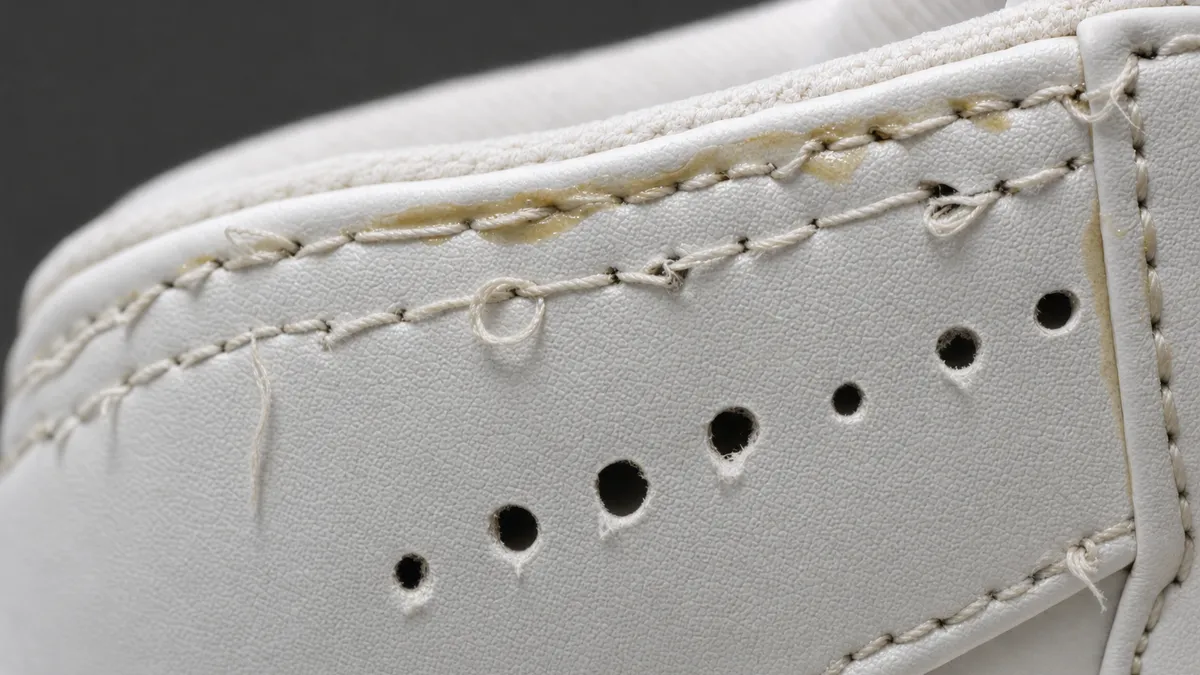 Replica
 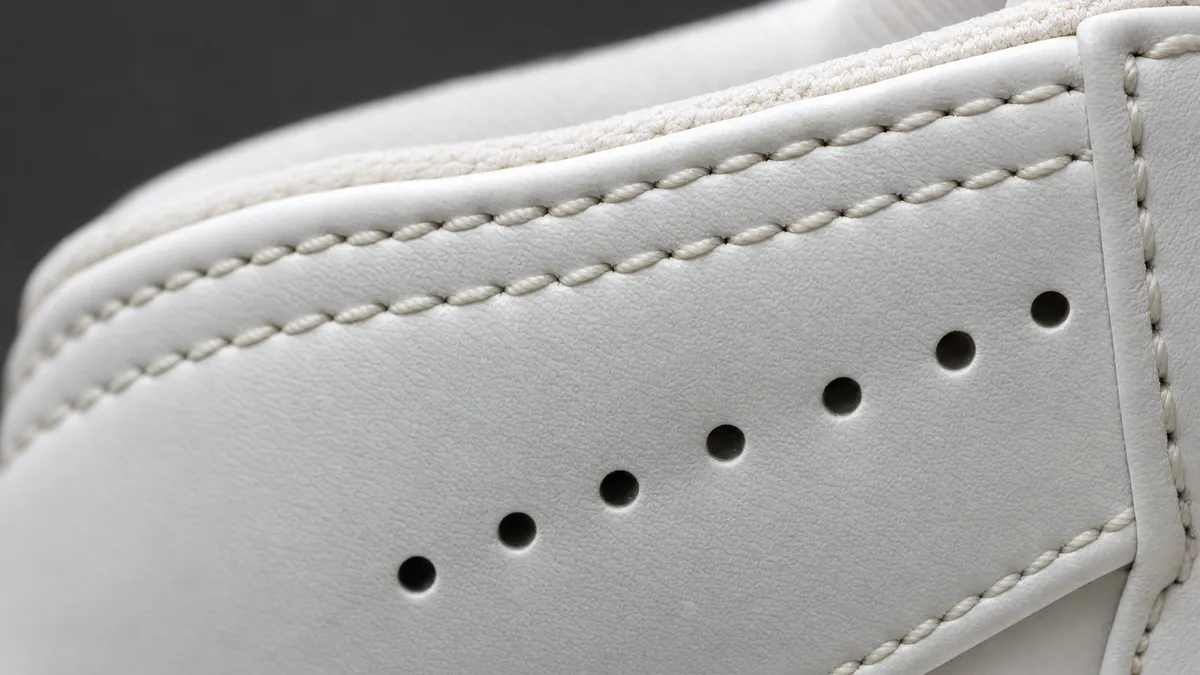 Authentic
 1. Wings stamp on the ankle
Authentic: A deep, crisp emboss: the feathers of the wings are drawn individually, the lines are clean, and the lettering reads clearly with no merged characters. This check is for the Air Jordan 1 only: from the 3 onward the stamp does not exist.
Fake: A shallow, mushy stamp: the feathers blur into a single blob, the lines are smeared or uneven, and the emboss depth is inconsistent.
2. Ankle collar and padding
Authentic: Moderate, firm collar padding that tapers neatly toward the heel and follows the shape of the ankle.
Fake: A puffy, overstuffed collar “pillow” – a classic replica tell; the padding bulges and never tapers to the heel.
3. The Swoosh
Authentic: A smooth taper with a thin, clean tail that ends at the right point, and even contour stitching with no glue.
Fake: A Swoosh that’s too thick, a sharp or wrong bend, wandering stitching, a crooked tail, or glue residue along the edge.
4. Rear heel silhouette (hourglass)
Authentic: Viewed from behind, the heel forms an “hourglass” silhouette – a clear taper at the middle above the sole; the last is clean. That silhouette belongs to the Air Jordan 1; the 3, 4, 5, 6 and 11 are built differently at the rear, so this check does not apply to them.
Fake: A straight or bloated heel with no defined taper at the middle, a puffy last, and off proportions on the rear.
5. Toe-box perforations
Authentic: Perforations of a uniform diameter, laid out in even rows with equal spacing. Toe-box perforation in this exact pattern and spacing is an Air Jordan 1 trait. The 3, 4, 5, 6 and 11 are built differently up front, so this description does not apply to them.
Fake: Holes of mixed sizes, rows that are tilted or shifted, and uneven spacing between the perforations.
6. Tongue tag and box
Authentic: The tongue tag is centered with a dense font and even stitching – and it matches the release: Nike Air on OG-spec pairs, a Jumpman on Mids and most Lows (the 2013 Chicago retro High also shipped with Jordan branding on the tag). The Style # on the size tag matches the box label.
Fake: A tag that’s off-center or sewn crooked with a thin, spindly font; branding that doesn’t match the release; a box Style # that doesn’t match the size tag, and typos on the label.
Popular Air Jordan models
Model-by-model checks – what to look at on each:
Where to inspect
The key zones to photograph and check on this type of item – a schematic, not a product photo.
- 1Logo shape and placement
- 2Toe box and upper shape
- 3Heel counter and tab
- 4Midsole and stitching
- 5Tongue and size tag
How to photograph your Air Jordan for a check
Shoot in daylight, avoid glare, keep focus sharp. You need 5 angles:
- 1 Full pair from the side
- 2 Close-up of the Wings stamp on the ankle (Air Jordan 1)
- 3 Heel from behind, hourglass silhouette (Air Jordan 1)
- 4 Swoosh and contour stitching
- 5 Size tag and box label
How to read the result
The AI returns a verdict with a confidence score:
- 75–100% – Authentic: high confidence the item is genuine.
- 60–74% – Likely authentic: probably genuine with minor concerns.
- 40–59% – Uncertain: the photos are not conclusive – retake or add angles.
- 25–39% – Likely fake: several red flags.
- 0–24% – Fake: clear signs of a replica.
Check your Air Jordan right now
Snap photos of your item and get an AI verdict with a confidence score in about a minute.
FAQ
What’s the most reliable sign of a fake Air Jordan 1?
There’s no single catch-all tell – the verdict comes from the sum of the details. But replicas most often give themselves away on the Wings stamp (mushy, merged feathers) and a puffy, overstuffed collar. Check those first, along with the heel silhouette and the shape of the Swoosh. The Wings stamp, the heel silhouette and the toe perforation are Air Jordan 1 traits.
What is the “hourglass” heel silhouette?
Looking at the shoe straight from the back, the heel of an authentic Air Jordan 1 tapers noticeably at the middle above the sole, forming a shape like an hourglass. Many fakes have a straight or bloated heel without that taper.
Can you spot a fake Jordan from the box alone?
No. Boxes are easy to copy. The box is useful for cross-checking the Style # and size against the tag inside the sneaker, but the verdict comes from the pair itself – the Wings stamp, collar, Swoosh, heel, and perforations. The Wings stamp, the heel silhouette and the toe perforation are Air Jordan 1 traits.
How accurate is an AI photo check for Air Jordans?
Accuracy depends on the quality and number of photos. LegitCheck AI cross-references the tells across all your angles and returns a verdict with a confidence score, flagging “uncertain” rather than guessing when the photos don’t support a definitive call. It’s a fast screening tool, not a legally binding authentication.