Guides · Sneakers
How to Tell if Your Nike Dunks Are Real or Fake (2026)
The Nike Dunk is back among the most-copied silhouettes: for hyped colorways like Panda and University Blue, reps show up before pairs even reach shelves. But Dunks give themselves away with their own specific mistakes – dirty color-block seams, a stubby misshapen Swoosh, and confusion between SB and standard retail. This guide covers the Dunk-specific tells, the right photo angles, and a way to verify a pair from photos in about a minute.
Real vs fake Nike Dunk: comparison table
Data current as of July 2026. Replicas evolve, so judge by the combination of signs – never a single one.
| Sign | Authentic | Fake |
|---|---|---|
| Swoosh shape and thickness | An even curve and a thin, tapered tail that ends at the correct point on the side panel; the outline stitching is uniform in width. | A Swoosh that’s too thick or short and stubby, curves too sharply, has a tail ending in the wrong place, or has outline stitching that wanders in width. |
| Color-block panel seams | The toe, side, and Swoosh panels meet cleanly with no overlap; the color transition is sharp with no paint bleed, and adjacent shades don’t mix. | Crooked seams between panels, sloppily trimmed leather, color that smears and bleeds onto the neighboring panel, and a shade that’s off for the colorway. |
| SB or retail (tongue and branding) | The SB Dunk has a thick, densely padded tongue, Nike SB branding, and a Zoom Air insole; the retail version (Dunk Low/High) has a thin tongue, a standard tag, and no Zoom Air. The insole is removable, so verify it by its markings rather than by how responsive the shoe feels. | An “SB” with a thin floppy unpadded tongue and a standard Nike tag instead of Nike SB branding – either retail passed off as SB, or the reverse. Compare the label against photos of your specific release: early SBs and some collabs use a different one. |
| Tongue label and style code | The woven Nike label on the tongue is sewn on straight with crisp type; the style code on the size tag matches the box label letter for letter. | A label that sits off-center or is sewn crooked, blurry type, or a style code on the tag that doesn’t match the box – a serious red flag. |
| Heel “Nike” embroidery | An embroidered “Nike” with dense, even stitches and uniform letter height, centered on the heel. | Letters that drift in height, sparse stitches, threads poking out, and a block that sits off-center. |
| Midsole and toe perforations | The midsole is cleanly painted with a straight line between sole and upper and no glue bleed; the toe perforations are one diameter, in evenly spaced rows. | A puffier midsole shape, a sole-to-upper join smeared with glue or paint, and perforations that vary in size with rows that drift or crowd the mudguard. |
The difference is in the details – drag the slider
Typical differences in workmanship: stitching consistency, edge finishing, detail quality. Left – factory quality, right – common replica flaws.
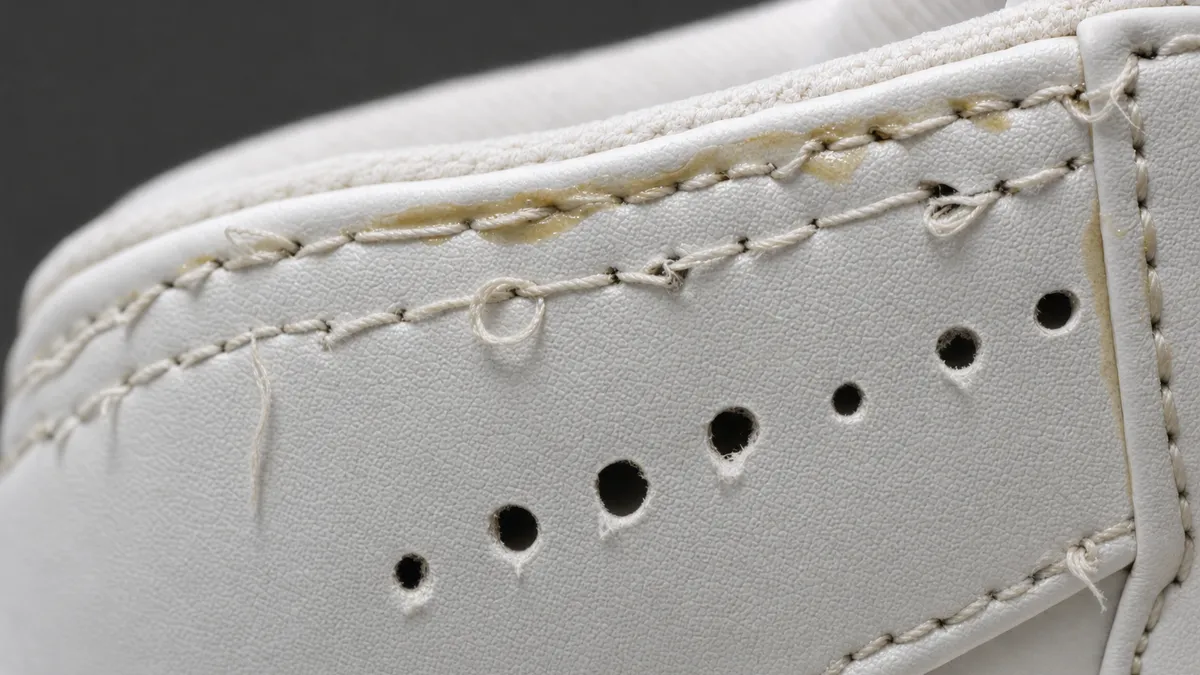 Replica
 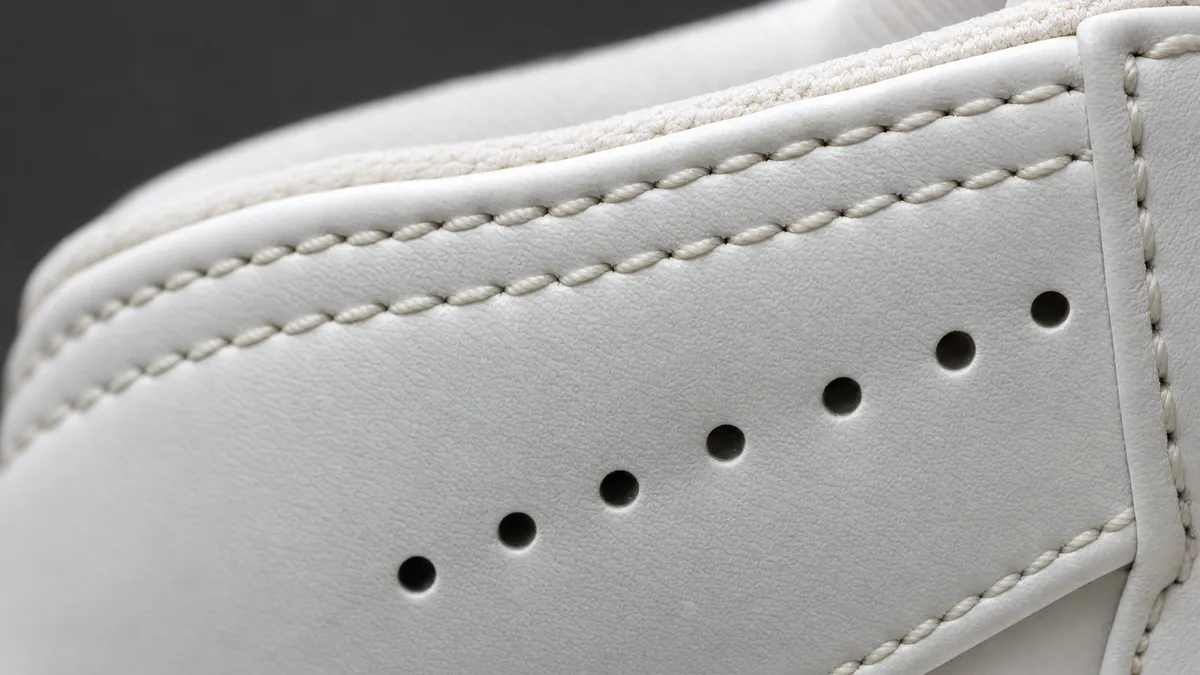 Authentic
 1. Swoosh shape and thickness
Authentic: An even curve and a thin, tapered tail that ends at the correct point on the side panel; the outline stitching is uniform in width.
Fake: A Swoosh that’s too thick or short and stubby, curves too sharply, has a tail ending in the wrong place, or has outline stitching that wanders in width.
2. Color-block panel seams
Authentic: The toe, side, and Swoosh panels meet cleanly with no overlap; the color transition is sharp with no paint bleed, and adjacent shades don’t mix.
Fake: Crooked seams between panels, sloppily trimmed leather, color that smears and bleeds onto the neighboring panel, and a shade that’s off for the colorway.
3. SB or retail (tongue and branding)
Authentic: The SB Dunk has a thick, densely padded tongue, Nike SB branding, and a Zoom Air insole; the retail version (Dunk Low/High) has a thin tongue, a standard tag, and no Zoom Air. The insole is removable, so verify it by its markings rather than by how responsive the shoe feels.
Fake: An “SB” with a thin floppy unpadded tongue and a standard Nike tag instead of Nike SB branding – either retail passed off as SB, or the reverse. Compare the label against photos of your specific release: early SBs and some collabs use a different one.
4. Tongue label and style code
Authentic: The woven Nike label on the tongue is sewn on straight with crisp type; the style code on the size tag matches the box label letter for letter.
Fake: A label that sits off-center or is sewn crooked, blurry type, or a style code on the tag that doesn’t match the box – a serious red flag.
5. Heel “Nike” embroidery
Authentic: An embroidered “Nike” with dense, even stitches and uniform letter height, centered on the heel.
Fake: Letters that drift in height, sparse stitches, threads poking out, and a block that sits off-center.
6. Midsole and toe perforations
Authentic: The midsole is cleanly painted with a straight line between sole and upper and no glue bleed; the toe perforations are one diameter, in evenly spaced rows.
Fake: A puffier midsole shape, a sole-to-upper join smeared with glue or paint, and perforations that vary in size with rows that drift or crowd the mudguard.
Popular Nike Dunk models
Model-by-model checks – what to look at on each:
Where to inspect
The key zones to photograph and check on this type of item – a schematic, not a product photo.
- 1Logo shape and placement
- 2Toe box and upper shape
- 3Heel counter and tab
- 4Midsole and stitching
- 5Tongue and size tag
How to photograph your Nike Dunk for a check
Shoot in daylight, avoid glare, keep focus sharp. You need 5 angles:
- 1 Full pair from the side
- 2 Close-up of the Swoosh and color-block seams
- 3 Tongue with its woven label (SB or standard Nike)
- 4 Heel “Nike” embroidery
- 5 Size tag with the style code, plus the box label
How to read the result
The AI returns a verdict with a confidence score:
- 75–100% – Authentic: high confidence the item is genuine.
- 60–74% – Likely authentic: probably genuine with minor concerns.
- 40–59% – Uncertain: the photos are not conclusive – retake or add angles.
- 25–39% – Likely fake: several red flags.
- 0–24% – Fake: clear signs of a replica.
Check your Nike Dunk right now
Snap photos of your item and get an AI verdict with a confidence score in about a minute.
FAQ
What’s the fastest way to spot a fake Nike Dunk?
Start with the Swoosh and the color-block seams. On a real pair the Swoosh is thin, with a tapered tail ending at the correct point, and the seams between panels are clean with no paint bleed. A thick, stubby Swoosh and color that bleeds onto the next panel are the most common fake tells specific to Dunks.
How does the SB Dunk differ from a regular Dunk, and why does it matter?
The SB Dunk is the skate version: a thick padded tongue, a chunkier last, Nike SB branding, and a Zoom Air insole. The standard (retail) Dunk Low/High has a thin tongue, no Zoom Air, and a plain tag. Confusing the two is the #1 mistake when checking Dunks – a thin, floppy tongue on a pair sold as an SB is a strong sign of a fake or a swap. That said, the insole is removable and may be missing on a used pair, and the SB label looks different on early releases and collabs – compare it to photos of your release.
What should I check on the Dunk style code?
The style code on the tongue tag must match the box label letter for letter. To verify the code and see which release it belongs to, use our Nike style-code checker. A mismatch between the tag and the box is a serious red flag.
How is this guide different from the general Nike guide?
This one covers the tells specific to Dunks: the Swoosh shape and where its tail ends on the panel, the cleanliness of the color-block seams, and the SB-versus-retail difference. The general Nike checks – stitching, materials, box – are covered in depth in the main guide: /blog/how-to-spot-fake-nike/. The two complement each other.