Guides · Sneakers
How to Tell if Your New Balance Sneakers Are Real or Fake (2026)
New Balance is no longer a “quiet” brand: the 990 series, the 550, and the 9060 get faked more and more, and replica quality keeps climbing. But the brand leaves consistent tells – from the texture of the “N” logo to the logic of origin (Made in USA versus Made in Asia). This guide covers 6 groups of tells, the exact photo angles to shoot, and a way to verify a pair from photos in about a minute.
Real vs fake New Balance: comparison table
Data current as of July 2026. Replicas evolve, so judge by the combination of signs – never a single one.
| Sign | Authentic | Fake |
|---|---|---|
| The “N” logo | A neat suede, felt, or leather overlay with sharp edges; tight, even stitching all the way around the outline and a straight, symmetrical placement on the sidewall. | Fuzzy or frayed edges, crooked or sparse stitching, glue residue along the outline, an “N” that’s glued on instead of stitched on a lifestyle silhouette (574, 550, 327, 530, the 990 series, 9060 – on running models the “N” may legitimately be bonded or printed), or a shifted, lopsided overlay. |
| Origin (Made in USA / England) | The 990 series (v1–v6), 992, 993, and 998 carry a genuine “Made in USA” mark; the 991 reads “Made in England.” The origin matches across the tongue, insole, and box. The mainstream lifestyle versions – 550, 327, 530, 9060 and the standard 574 – are Asia-made, but the 574 also has a separate, pricier Made in USA line (US574… codes) where a USA mark is legitimate. | A “Made in USA” mark on a pair whose style code and build match the Asian version; or the country mismatching between the tongue label, insole, and box. |
| Midsole tech text | “ENCAP,” “ABZORB,” or “N-ergy” is molded cleanly and evenly, and appears only on the models that genuinely use that technology. | Smudged, crooked, or shallow lettering, misspelled “ABZORB”/“ENCAP,” or a “technology” stamped on a model that doesn’t have it. |
| Tongue label and style code | Crisp printing, correct size conversions (US/UK/EU/CM), a style code on the tongue label that matches the box label, and a label sewn on straight. | Blurry printing, size conversions that don’t line up, a style code that doesn’t match the box, or a crooked, misaligned label. |
| Materials and stitching | Dense, quality suede and breathable mesh, with clean stitches of uniform length and neatly punched perforations with no burrs. | Thin, “plasticky” suede, coarse mesh, uneven stitches, skipped stitches with loose threads, and ragged perforations. |
| Outsole, insole, and heel branding | Firm rubber with a sharp tread pattern, an even glue line, cleanly embroidered or embossed heel branding, and a legible insole stamp. | Cheap glossy plastic instead of matte rubber, a blurred, poorly defined tread pattern, a wavy glue line with gaps, crooked heel embroidery, and a smudged or missing insole stamp. |
The difference is in the details – drag the slider
Typical differences in workmanship: stitching consistency, edge finishing, detail quality. Left – factory quality, right – common replica flaws.
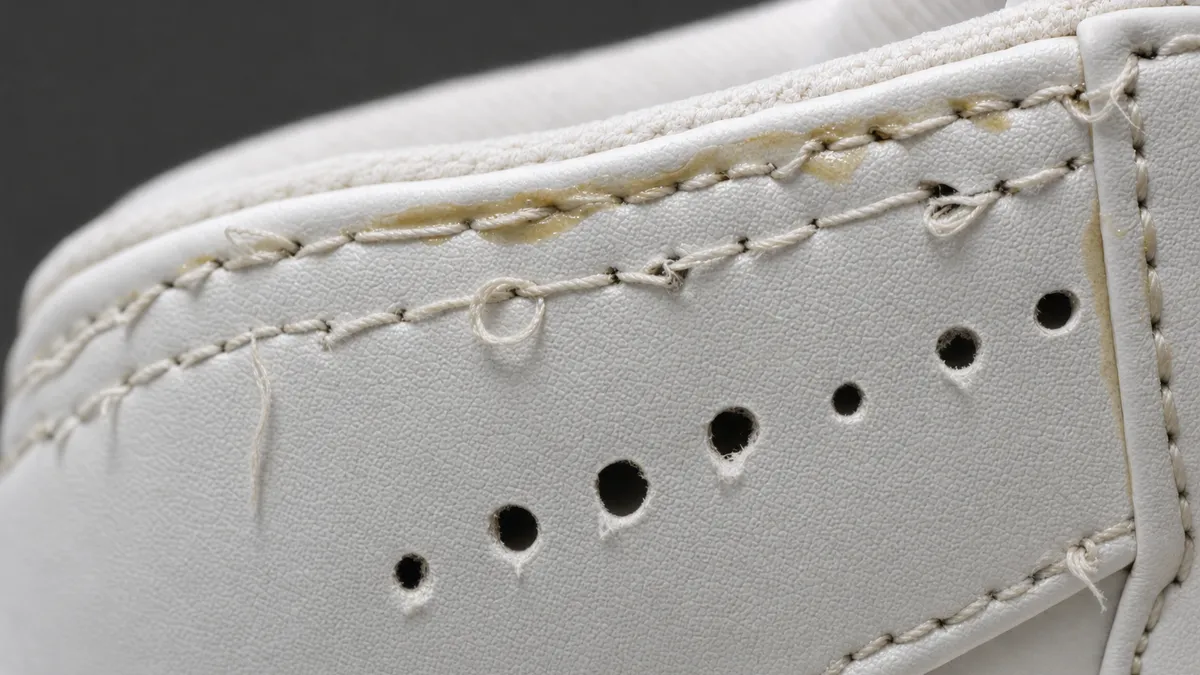 Replica
 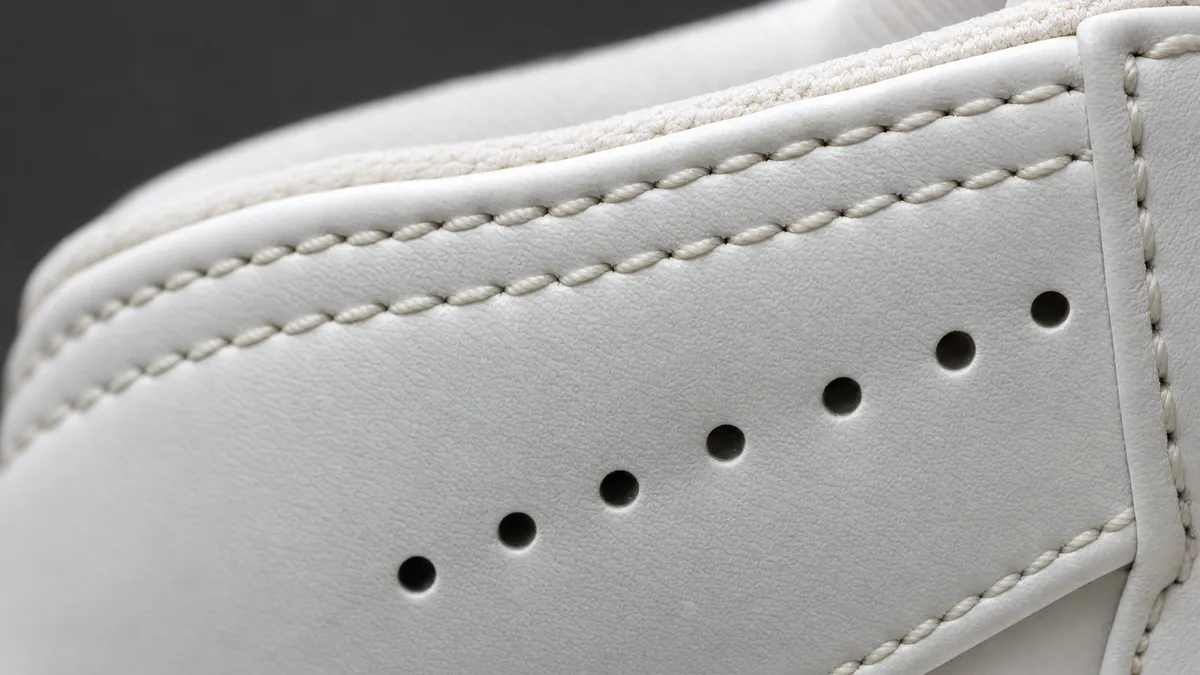 Authentic
 1. The “N” logo
Authentic: A neat suede, felt, or leather overlay with sharp edges; tight, even stitching all the way around the outline and a straight, symmetrical placement on the sidewall.
Fake: Fuzzy or frayed edges, crooked or sparse stitching, glue residue along the outline, an “N” that’s glued on instead of stitched on a lifestyle silhouette (574, 550, 327, 530, the 990 series, 9060 – on running models the “N” may legitimately be bonded or printed), or a shifted, lopsided overlay.
2. Origin (Made in USA / England)
Authentic: The 990 series (v1–v6), 992, 993, and 998 carry a genuine “Made in USA” mark; the 991 reads “Made in England.” The origin matches across the tongue, insole, and box. The mainstream lifestyle versions – 550, 327, 530, 9060 and the standard 574 – are Asia-made, but the 574 also has a separate, pricier Made in USA line (US574… codes) where a USA mark is legitimate.
Fake: A “Made in USA” mark on a pair whose style code and build match the Asian version; or the country mismatching between the tongue label, insole, and box.
3. Midsole tech text
Authentic: “ENCAP,” “ABZORB,” or “N-ergy” is molded cleanly and evenly, and appears only on the models that genuinely use that technology.
Fake: Smudged, crooked, or shallow lettering, misspelled “ABZORB”/“ENCAP,” or a “technology” stamped on a model that doesn’t have it.
4. Tongue label and style code
Authentic: Crisp printing, correct size conversions (US/UK/EU/CM), a style code on the tongue label that matches the box label, and a label sewn on straight.
Fake: Blurry printing, size conversions that don’t line up, a style code that doesn’t match the box, or a crooked, misaligned label.
5. Materials and stitching
Authentic: Dense, quality suede and breathable mesh, with clean stitches of uniform length and neatly punched perforations with no burrs.
Fake: Thin, “plasticky” suede, coarse mesh, uneven stitches, skipped stitches with loose threads, and ragged perforations.
6. Outsole, insole, and heel branding
Authentic: Firm rubber with a sharp tread pattern, an even glue line, cleanly embroidered or embossed heel branding, and a legible insole stamp.
Fake: Cheap glossy plastic instead of matte rubber, a blurred, poorly defined tread pattern, a wavy glue line with gaps, crooked heel embroidery, and a smudged or missing insole stamp.
Popular New Balance models
Model-by-model checks – what to look at on each:
Where to inspect
The key zones to photograph and check on this type of item – a schematic, not a product photo.
- 1Logo shape and placement
- 2Toe box and upper shape
- 3Heel counter and tab
- 4Midsole and stitching
- 5Tongue and size tag
How to photograph your New Balance for a check
Shoot in daylight, avoid glare, keep focus sharp. You need 5 angles:
- 1 Full pair from the side
- 2 Close-up of the “N” logo
- 3 Tongue label and inside size tag
- 4 Midsole tech text (ENCAP/ABZORB)
- 5 Sole and box label
How to read the result
The AI returns a verdict with a confidence score:
- 75–100% – Authentic: high confidence the item is genuine.
- 60–74% – Likely authentic: probably genuine with minor concerns.
- 40–59% – Uncertain: the photos are not conclusive – retake or add angles.
- 25–39% – Likely fake: several red flags.
- 0–24% – Fake: clear signs of a replica.
Check your New Balance right now
Snap photos of your item and get an AI verdict with a confidence score in about a minute.
FAQ
Are all New Balance shoes made in the USA?
No. “Made in USA” applies to certain series: the 990 (v1–v6), 992, 993, and 998; the 991 is built in England. The mainstream lifestyle versions – the 550, 327, 530, 9060, and the standard 574 – are made in Asia. The exception is the separate, pricier 574 Made in USA line (US574… codes), where the USA mark is legitimate. The red flag is “Made in USA” on a pair whose style code and build match the Asian version, or the country mismatching between the tongue label, insole, and box.
What do ENCAP, ABZORB, and N-ergy on the sole mean?
They’re New Balance cushioning technologies. The molding should be crisp and appear only on models that actually use that tech. Smudged text, a misspelling, or “ABZORB” on a model that doesn’t have it is a reason to be suspicious.
What’s the quickest way to check the “N” logo?
Look at the edges and the stitching: on authentic pairs the suede, felt, or leather overlay has clean edges and tight, even stitching around the outline, with no glue. Fuzzy edges, sparse or crooked stitching, and a glued-on “N” are classic fake tells. This applies to the lifestyle silhouettes (574, 550, 327, 530, the 990 series, 9060): on running models the “N” may be bonded or printed, which is normal.
How accurate is an AI photo check for New Balance?
Accuracy depends on the quality and number of photos. LegitCheck AI cross-references the tells across all your angles and returns a verdict with a confidence score, flagging “uncertain” rather than guessing when the photos don’t support a definitive call. It’s a fast screening tool, not a legally binding authentication.