Guides · Luxury Clothing
How to Tell if Your Burberry Is Real or Fake (2026)
Burberry — the British house founded by Thomas Burberry in 1856 — is one of the most counterfeited luxury brands: trench coats, check shirts, polos, and TB-monogram pieces get copied at scale. The real thing rests on three pillars: the symmetry of the Burberry Check and how it matches across seams, a logo that fits the piece’s era, and fabric quality — from the house gabardine to dense piqué. It’s the check, the tags, and the material where replicas give themselves away most often.
Real vs fake Burberry: comparison table
Data current as of July 2026. Replicas evolve, so judge by the combination of signs — never a single one.
| Sign | Authentic | Fake |
|---|---|---|
| Check pattern and seam matching | The Burberry Check is symmetrical, the stripes run even, and the camel/black/red/white tones stay clean; the pattern matches across seams, plackets, and pockets — panels are cut to respect the repeat. | The check drifts at the joins, stripes vary in width, the camel reads muddy or oversaturated; on printed replicas the pattern looks flat and blurry. |
| Logo and its era | The logo fits the piece’s era: the Equestrian Knight, “BURBERRY LONDON ENGLAND,” or the TB monogram — with precise geometry, the house typeface, and even kerning. | A mix of logos from different eras on one piece, a near-miss typeface, a blurred knight, a broken TB interlock, mangled letter spacing. |
| Neck label and tag set | A woven neck label with a crisp font, separate size and composition/care tags carrying a style code; the layout and attachment match references for the release. | Blurry printing, a one-size-fits-all label, a crooked seam, a tag set that doesn’t correspond to the release. |
| Fabric: gabardine, cotton, piqué | Trench gabardine is dense with a fine, even diagonal weave and holds its shape; tee and hoodie cotton is heavyweight, and polo piqué is springy with a uniform grain. | Thin, loose fabric with a synthetic sheen; the piece hangs limp and loses its silhouette, and the piqué stretches out after one wear. |
| Hardware and buttons | Substantial buttons, often brand-marked, sewn on firmly and evenly; buckles and zips operate smoothly with no play. | Light, plasticky buttons with no markings, careless attachment, hardware that rattles or snags. |
| Stitching, seams and lining | Even, dense stitching throughout, tidy hems, a lining sewn in without skew; embroidery is tight with a clean outline. | Wandering stitch length, stray threads, a rippling lining, crooked hems, and loose embroidery with gaps. |
The difference is in the details — drag the slider
Typical differences in workmanship: stitching consistency, edge finishing, detail quality. Left — factory quality, right — common replica flaws.
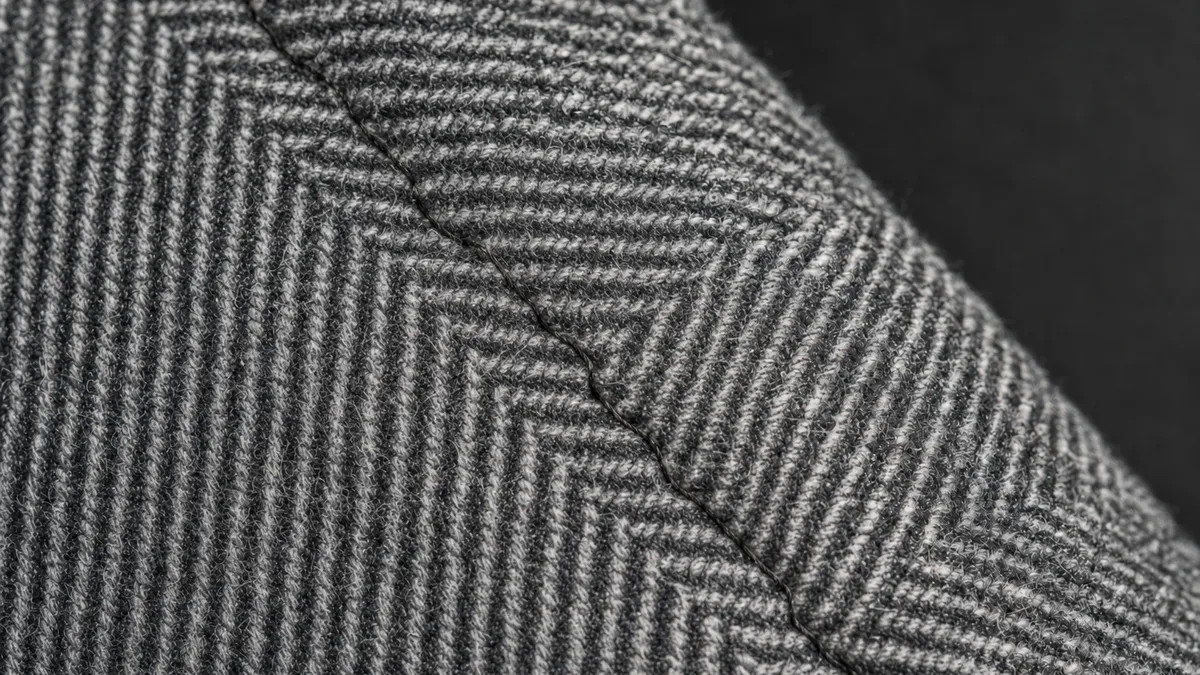 Replica
 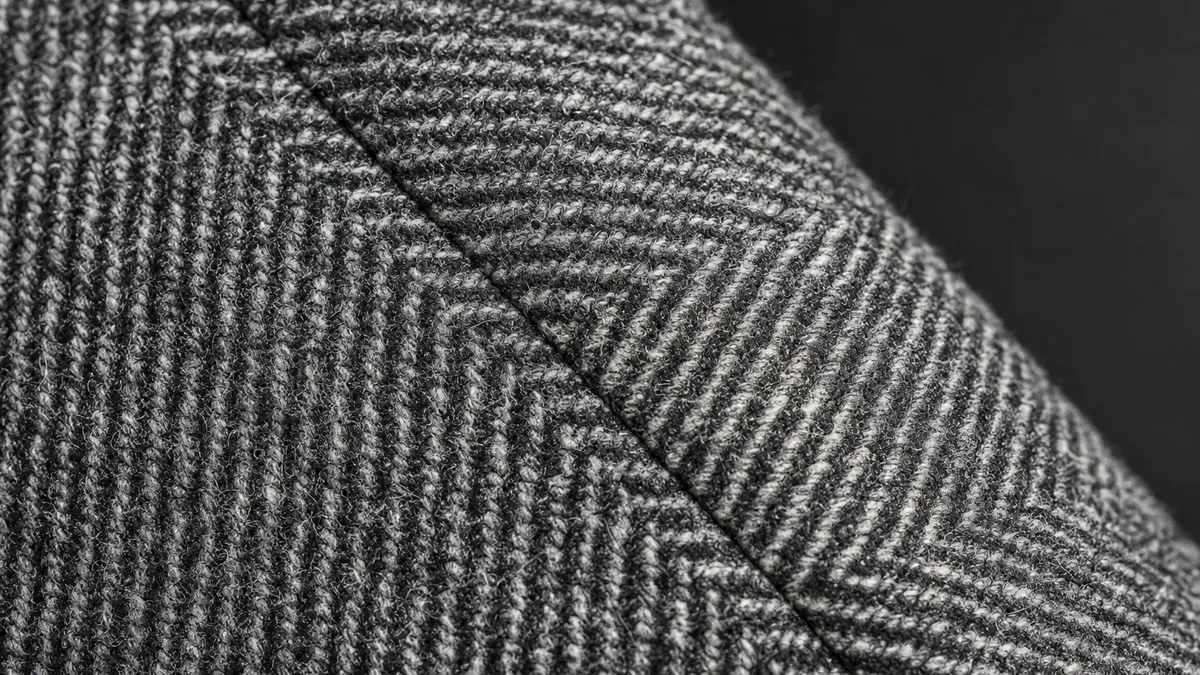 Authentic
 1. Check pattern and seam matching
Authentic: The Burberry Check is symmetrical, the stripes run even, and the camel/black/red/white tones stay clean; the pattern matches across seams, plackets, and pockets — panels are cut to respect the repeat.
Fake: The check drifts at the joins, stripes vary in width, the camel reads muddy or oversaturated; on printed replicas the pattern looks flat and blurry.
2. Logo and its era
Authentic: The logo fits the piece’s era: the Equestrian Knight, “BURBERRY LONDON ENGLAND,” or the TB monogram — with precise geometry, the house typeface, and even kerning.
Fake: A mix of logos from different eras on one piece, a near-miss typeface, a blurred knight, a broken TB interlock, mangled letter spacing.
3. Neck label and tag set
Authentic: A woven neck label with a crisp font, separate size and composition/care tags carrying a style code; the layout and attachment match references for the release.
Fake: Blurry printing, a one-size-fits-all label, a crooked seam, a tag set that doesn’t correspond to the release.
4. Fabric: gabardine, cotton, piqué
Authentic: Trench gabardine is dense with a fine, even diagonal weave and holds its shape; tee and hoodie cotton is heavyweight, and polo piqué is springy with a uniform grain.
Fake: Thin, loose fabric with a synthetic sheen; the piece hangs limp and loses its silhouette, and the piqué stretches out after one wear.
5. Hardware and buttons
Authentic: Substantial buttons, often brand-marked, sewn on firmly and evenly; buckles and zips operate smoothly with no play.
Fake: Light, plasticky buttons with no markings, careless attachment, hardware that rattles or snags.
6. Stitching, seams and lining
Authentic: Even, dense stitching throughout, tidy hems, a lining sewn in without skew; embroidery is tight with a clean outline.
Fake: Wandering stitch length, stray threads, a rippling lining, crooked hems, and loose embroidery with gaps.
Popular Burberry models
Model-by-model checks — what to look at on each:
Where to inspect
The key zones to photograph and check on this type of item — a schematic, not a product photo.
- 1Neck label and tags
- 2Print and its printing
- 3Stitching and hem
- 4Shoulder and sleeve seam
- 5Fabric and weight
How to photograph your Burberry for a check
Shoot in daylight, avoid glare, keep focus sharp. You need 5 angles:
- 1 Full item (front)
- 2 Check pattern at a seam, placket, or lining close-up
- 3 Logo or embroidery close-up
- 4 Neck label and tags with the style code
- 5 Buttons and hardware
How to read the result
The AI returns a verdict with a confidence score:
- 75–100% — Authentic: high confidence the item is genuine.
- 60–74% — Likely authentic: probably genuine with minor concerns.
- 40–59% — Uncertain: the photos are not conclusive — retake or add angles.
- 25–39% — Likely fake: several red flags.
- 0–24% — Fake: clear signs of a replica.
Check your Burberry right now
Snap photos of your item and get an AI verdict with a confidence score in about a minute.
FAQ
What’s the fastest Burberry tell?
Pattern matching at the seams. On the real thing the Burberry Check continues across plackets, pockets, and panel joins without breaking — the cut respects the repeat. On replicas the check almost always drifts at the seams, and the camel tones read muddy or oversaturated. Don’t invent exact check dimensions — compare against photos of a confirmed original.
Can I look up the code on a Burberry tag?
No. Style codes on Burberry labels do exist, but there is no public database to verify them, and it’s not worth reverse-engineering the code format from internet articles — counterfeiters simply copy codes from genuine pieces, so a “correct” code proves nothing on its own. What works instead: verify the full tag set — neck label, size, composition/care — its fonts, layout, and attachment against references for the specific release.
What’s the correct country of manufacture for Burberry?
There’s no single answer: Burberry has long produced across multiple locations, so the country on the tag isn’t a verdict by itself. What is suspicious: a country that doesn’t agree with the rest of the tag set or with release references, blurry printing, and composition errors.
Is the knight logo an outdated version — or a fake?
Neither, on its own. The Equestrian Knight is the house’s historic emblem; the Tisci era replaced it with the strict wordmark and TB monogram, and the latest era brought the knight back. So match the logo to the specific piece’s era and release rather than to one “correct” version. The app tells you which angles to shoot and cross-references the piece against the release.