Guides · Luxury Clothing
How to Tell if Your Maison Margiela Is Real or Fake (2026)
Maison Margiela is the Paris house Martin Margiela founded in 1988, built on anonymity: instead of loud logos, a blank white label, four white stitches on the back, and a calendar tag numbered 0–23. The paradox is that these quiet markers are the easiest to verify — and exactly where replicas slip: a decorative imitation of the stitches, a crooked circle around the line number, and cheap fabric standing in for the real thing.
Real vs fake Maison Margiela: comparison table
Data current as of July 2026. Replicas evolve, so judge by the combination of signs — never a single one.
| Sign | Authentic | Fake |
|---|---|---|
| The four back stitches | A real hand attachment: the thread passes through and genuinely holds the label inside; the stitches look slightly organic, not perfectly identical. | A decorative machine imitation: perfectly uniform stitches with no connection to the label inside, or no label on the reverse at all. |
| The 0–23 calendar tag | Numbers set in the house font with equal spacing; the circled number matches the garment’s line (check the official legend). | An off number font, drifting intervals, a crooked or offset circle, or the wrong line’s number circled. |
| The blank label | A clean white label in tidy fabric with a straight edge; attached in a way consistent with the garment’s construction. | Coarse fabric, a ragged edge, a label machine-sewn around its full perimeter, or no label at all. |
| Composition and care tags | Clean printing with no typos and a correct text layout; the country of origin (often Italy) matches confirmed originals of the release. | Faded or smudged printing, composition errors, a “one-size-fits-all” label, a country that doesn’t match reference. |
| Fabric, knit and fit | Quality dense fabric or an even, tight knit; the piece holds its shape and fits true to the release pattern. | Thin, loose fabric, uneven loops, out-of-the-box pilling, a silhouette that hangs differently from reference photos. |
| Stitching and details | Even, dense stitching with tidy hems; applied details (such as elbow patches) sit symmetrically and are sewn on cleanly. | Wandering stitch length, rippling hems, loose threads, asymmetric or crudely attached details. |
The difference is in the details — drag the slider
Typical differences in workmanship: stitching consistency, edge finishing, detail quality. Left — factory quality, right — common replica flaws.
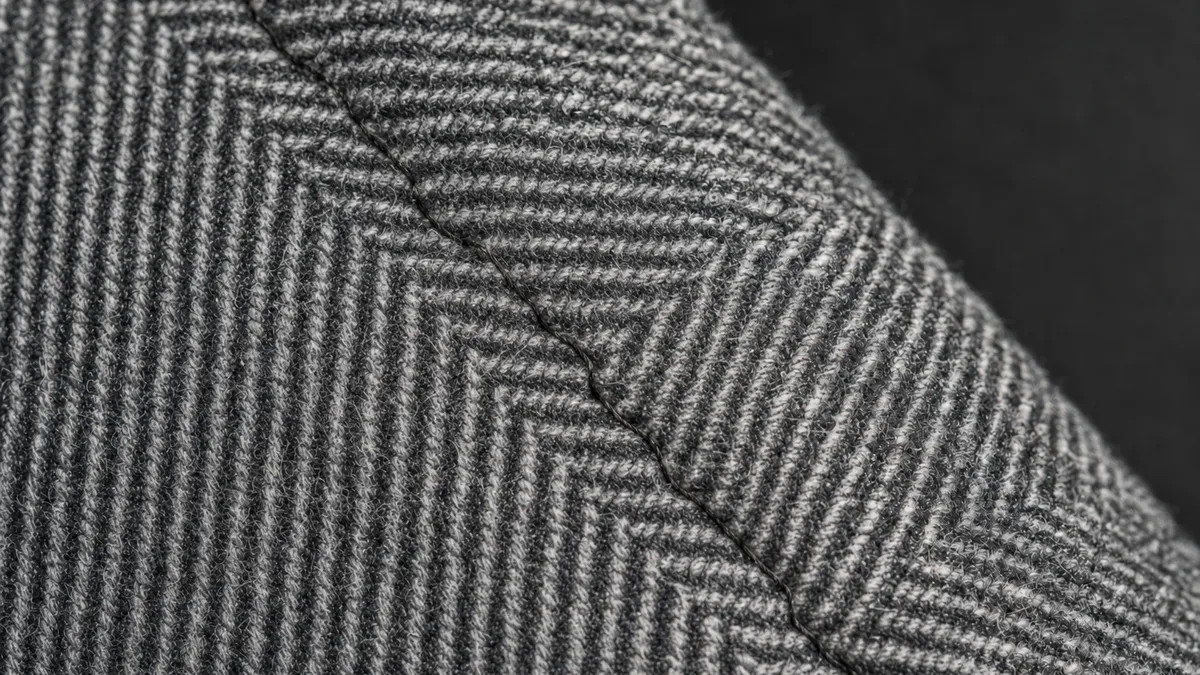 Replica
 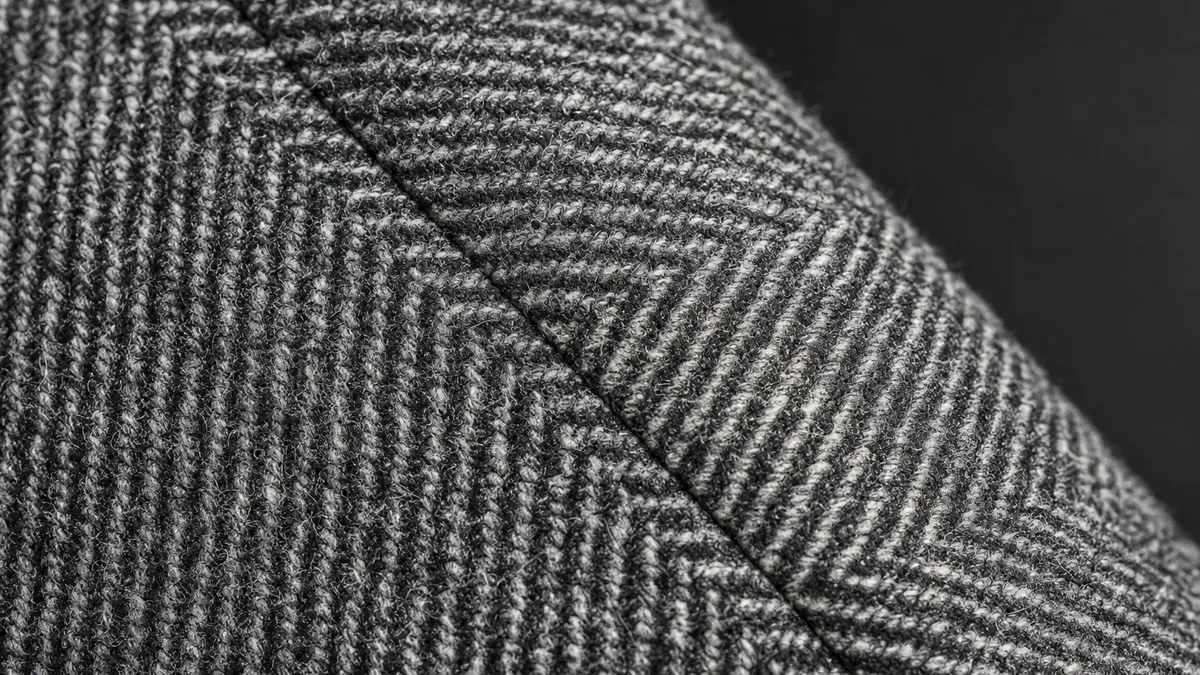 Authentic
 1. The four back stitches
Authentic: A real hand attachment: the thread passes through and genuinely holds the label inside; the stitches look slightly organic, not perfectly identical.
Fake: A decorative machine imitation: perfectly uniform stitches with no connection to the label inside, or no label on the reverse at all.
2. The 0–23 calendar tag
Authentic: Numbers set in the house font with equal spacing; the circled number matches the garment’s line (check the official legend).
Fake: An off number font, drifting intervals, a crooked or offset circle, or the wrong line’s number circled.
3. The blank label
Authentic: A clean white label in tidy fabric with a straight edge; attached in a way consistent with the garment’s construction.
Fake: Coarse fabric, a ragged edge, a label machine-sewn around its full perimeter, or no label at all.
4. Composition and care tags
Authentic: Clean printing with no typos and a correct text layout; the country of origin (often Italy) matches confirmed originals of the release.
Fake: Faded or smudged printing, composition errors, a “one-size-fits-all” label, a country that doesn’t match reference.
5. Fabric, knit and fit
Authentic: Quality dense fabric or an even, tight knit; the piece holds its shape and fits true to the release pattern.
Fake: Thin, loose fabric, uneven loops, out-of-the-box pilling, a silhouette that hangs differently from reference photos.
6. Stitching and details
Authentic: Even, dense stitching with tidy hems; applied details (such as elbow patches) sit symmetrically and are sewn on cleanly.
Fake: Wandering stitch length, rippling hems, loose threads, asymmetric or crudely attached details.
Popular Maison Margiela models
Model-by-model checks — what to look at on each:
Where to inspect
The key zones to photograph and check on this type of item — a schematic, not a product photo.
- 1Neck label and tags
- 2Print and its printing
- 3Stitching and hem
- 4Shoulder and sleeve seam
- 5Fabric and weight
How to photograph your Maison Margiela for a check
Shoot in daylight, avoid glare, keep focus sharp. You need 5 angles:
- 1 Back with the four stitches close-up
- 2 Calendar tag with the 0–23 numbers
- 3 Blank label from the inside
- 4 Logo or print close-up
- 5 Composition tag and size label
How to read the result
The AI returns a verdict with a confidence score:
- 75–100% — Authentic: high confidence the item is genuine.
- 60–74% — Likely authentic: probably genuine with minor concerns.
- 40–59% — Uncertain: the photos are not conclusive — retake or add angles.
- 25–39% — Likely fake: several red flags.
- 0–24% — Fake: clear signs of a replica.
Check your Maison Margiela right now
Snap photos of your item and get an AI verdict with a confidence score in about a minute.
FAQ
What do the four white stitches on the back mean?
They’re Maison Margiela’s signature: the blank label is hand-tacked to the garment with four stitches from the inside, and the thread is deliberately left visible outside — the owner can snip the label off and keep the piece anonymous. Check the character of the stitches: on the original it’s a real attachment; on replicas, a decorative imitation with no connection to the label.
How do I read the calendar number tag?
The tag carries a row of numbers from 0 to 23, each standing for a house line; the circled number marks the line of that specific garment. The best known: 1 for women’s, 10 for men’s, 6 for MM6. Check the full list against the official line legend — and make sure the circled digit matches the type of garment.
Is checking MM6 different from the main line?
Yes. MM6 is the diffusion line with its own label design and its own design language; on the calendar scale it corresponds to the number 6. Compare an MM6 piece against confirmed MM6 originals from the same period — fakes often mix mainline and diffusion elements.
Can one signal alone prove a fake?
A reliable verdict comes from the combination: stitches + calendar tag + blank label + fabric and fit. Replicas have learned to copy any single marker, but faking all four zones together is far harder. The app tells you which angles to shoot and cross-checks the piece across every zone at once.