Guides · Luxury Clothing
How to Tell if Your Balmain Is Real or Fake (2026)
Balmain is the Paris house founded by Pierre Balmain in 1945; today its calling cards are double-breasted blazers with gold crest buttons, biker jeans, and pieces carrying the “BALMAIN PARIS” wordmark and PB monogram. The real thing rests on three pillars: the quality of the hardware and buttons, exact logo typography, and a consistent tag set. It’s the crest relief, the font, and the labels where replicas give themselves away most often.
Real vs fake Balmain: comparison table
Data current as of July 2026. Replicas evolve, so judge by the combination of signs — never a single one.
| Sign | Authentic | Fake |
|---|---|---|
| Gold crest buttons | Deep, detailed crest relief, real weight, an even finish with no casting flash; buttons sit straight, and the rows are symmetrical with equal intervals. | Flat, mushy relief, lightweight buttons, uneven gilt, tilted seating, and rows that wander. |
| “BALMAIN PARIS” typography | The strict house typeface: even kerning, correct stroke weight, a precise interval between the “BALMAIN” and “PARIS” lines; the print or flock is dense and sharp. | A near-miss typeface (close but not it), broken letter spacing, blurred letter edges, shedding flock. |
| PB monogram and labyrinth pattern | Exact geometry of the interlocking “P” and “B,” equal line weight, a continuous repeat that meets deliberately at the seams. | Distorted or wrongly mirrored elements, a floating pattern pitch, a chaotic motif break at the seams. |
| Neck label and tag set | A woven Balmain label with a sharp font, sewn on straight; the size and composition tags agree with each other and with the release. | Blurry lettering, a wrong layout, a crooked seam, a “one-size-fits-all” label, an inconsistent tag set. |
| Fabric, cut and construction | Dense, well-finished materials; the construction holds its shape — the blazer’s sharp structured shoulder, the biker jeans’ dimensional ribbing, knitwear with real weight. | Thin fabric, a soft hollow shoulder, flat uneven ribbing, slack ribbed trims, fabric that stretches out. |
| Hardware, seams and finishing | Zippers run smoothly with clean engraving; the stitching is straight and dense, buttonholes are neatly finished, and the lining lies flat. | Snagging zippers, lightweight hardware with shallow engraving, wandering stitch length, loose buttonholes, a puckering lining. |
The difference is in the details — drag the slider
Typical differences in workmanship: stitching consistency, edge finishing, detail quality. Left — factory quality, right — common replica flaws.
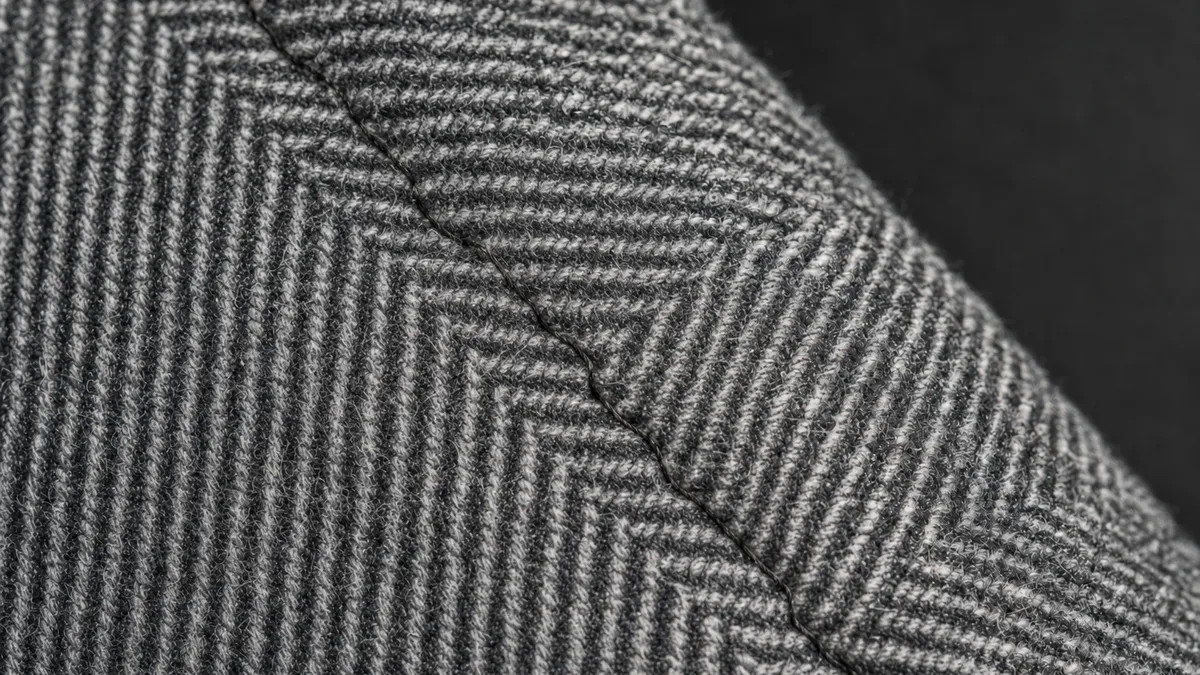 Replica
 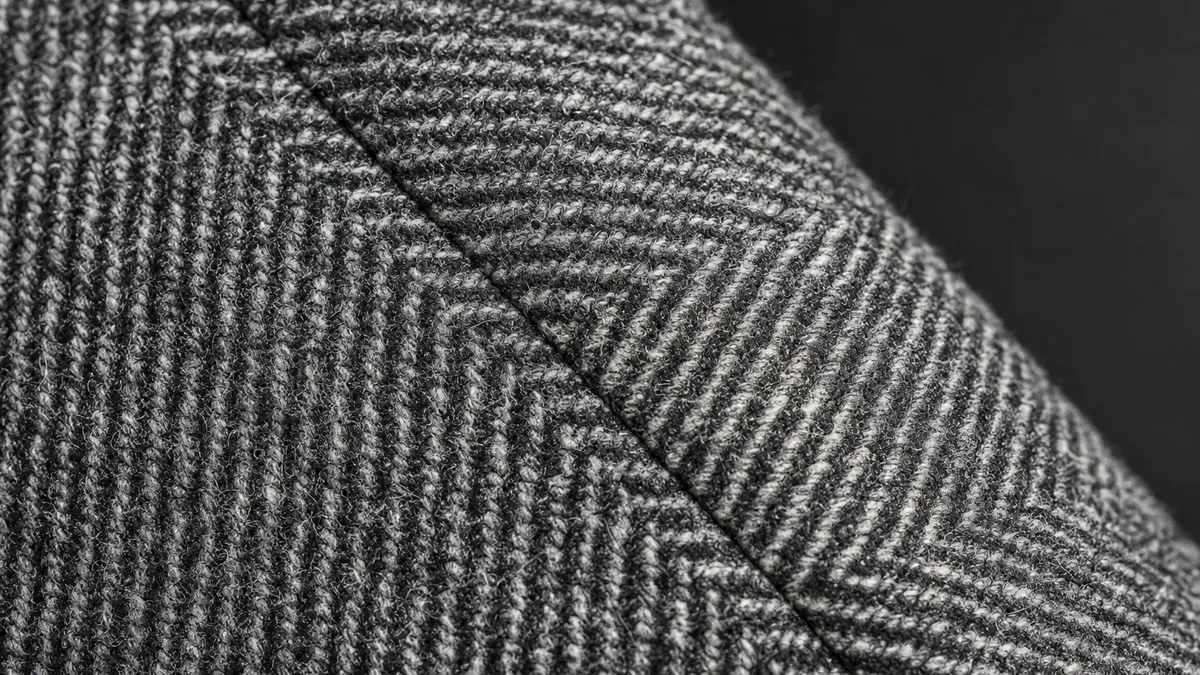 Authentic
 1. Gold crest buttons
Authentic: Deep, detailed crest relief, real weight, an even finish with no casting flash; buttons sit straight, and the rows are symmetrical with equal intervals.
Fake: Flat, mushy relief, lightweight buttons, uneven gilt, tilted seating, and rows that wander.
2. “BALMAIN PARIS” typography
Authentic: The strict house typeface: even kerning, correct stroke weight, a precise interval between the “BALMAIN” and “PARIS” lines; the print or flock is dense and sharp.
Fake: A near-miss typeface (close but not it), broken letter spacing, blurred letter edges, shedding flock.
3. PB monogram and labyrinth pattern
Authentic: Exact geometry of the interlocking “P” and “B,” equal line weight, a continuous repeat that meets deliberately at the seams.
Fake: Distorted or wrongly mirrored elements, a floating pattern pitch, a chaotic motif break at the seams.
4. Neck label and tag set
Authentic: A woven Balmain label with a sharp font, sewn on straight; the size and composition tags agree with each other and with the release.
Fake: Blurry lettering, a wrong layout, a crooked seam, a “one-size-fits-all” label, an inconsistent tag set.
5. Fabric, cut and construction
Authentic: Dense, well-finished materials; the construction holds its shape — the blazer’s sharp structured shoulder, the biker jeans’ dimensional ribbing, knitwear with real weight.
Fake: Thin fabric, a soft hollow shoulder, flat uneven ribbing, slack ribbed trims, fabric that stretches out.
6. Hardware, seams and finishing
Authentic: Zippers run smoothly with clean engraving; the stitching is straight and dense, buttonholes are neatly finished, and the lining lies flat.
Fake: Snagging zippers, lightweight hardware with shallow engraving, wandering stitch length, loose buttonholes, a puckering lining.
Popular Balmain models
Model-by-model checks — what to look at on each:
Where to inspect
The key zones to photograph and check on this type of item — a schematic, not a product photo.
- 1Neck label and tags
- 2Print and its printing
- 3Stitching and hem
- 4Shoulder and sleeve seam
- 5Fabric and weight
How to photograph your Balmain for a check
Shoot in daylight, avoid glare, keep focus sharp. You need 5 angles:
- 1 Full item (front)
- 2 Buttons or logo close-up
- 3 Neck tag
- 4 Size and composition tags
- 5 Hardware and stitching
How to read the result
The AI returns a verdict with a confidence score:
- 75–100% — Authentic: high confidence the item is genuine.
- 60–74% — Likely authentic: probably genuine with minor concerns.
- 40–59% — Uncertain: the photos are not conclusive — retake or add angles.
- 25–39% — Likely fake: several red flags.
- 0–24% — Fake: clear signs of a replica.
Check your Balmain right now
Snap photos of your item and get an AI verdict with a confidence score in about a minute.
FAQ
What’s the fastest Balmain tell?
The combination of “buttons + typography.” On blazers and gold-hardware pieces, check the crest relief and button weight first; on tees and hoodies, the “BALMAIN PARIS” font with its kerning and line spacing. Replicas almost always miss at least one of these zones.
Where is Balmain made — what does the “made in” tag mean?
Production is placed across different factories (often Europe or Asia, depending on the line and the type of piece), so the country on the tag proves nothing on its own: both “Made in Italy” and other markings appear on genuine items, and counterfeits happily copy the “prestigious” labels. Match the full tag set — fonts, layout, composition — against documented references for the specific release.
How do I check the gold buttons without a reference on hand?
The general tests: the crest relief should be deep and detailed, the button should have real weight, it should sit straight with no tilt, and the rows should be symmetrical. Then find photos of a confirmed original from the same release and match the crest design — relying on a general impression alone is risky.
Is a photo of the logo enough for a verdict?
The logo is a strong signal, but a reliable verdict comes from the combination: typography + buttons/hardware + tags + fabric and construction. The app tells you which angles to shoot, analyzes each zone, and returns a verdict with a confidence score.