Guides · Trading Cards
How to Tell if Your Panini Cards Are Real or Fake (2026)
Panini's flagship lines – Prizm, Select, Donruss Optic, Mosaic, National Treasures – are built around chrome foil and dozens of color parallels, and the priciest rookie cards and autographs are counterfeited heavily. The good news: almost every fake gives itself away on print, foil, and fine detail front to back – all visible in a photo, with no destructive test required. It is just as important not to mistake genuine factory characteristics (mild miscut, print dots, edge foil chipping) for fake tells: those affect the grade, not authenticity.
Real vs fake Panini: comparison table
Data current as of July 2026. Replicas evolve, so judge by the combination of signs – never a single one.
| Sign | Authentic | Fake |
|---|---|---|
| Print quality | Under a loupe you see an even rosette of dots and clean color registration, with sharp text and no halo. | Blurry dots or a striped screen, misregistered colors, halos and re-scan artifacts around fine text. |
| Foil and prism effect on tilt | A geometric refraction pattern matching the card's stated parallel (diagonal lines, waves, swirls and others on Prizm/Select/Optic; facets only on Mosaic's named parallels, with base cards possibly showing none) that shifts smoothly and coherently across the whole surface. | A grainy or oily film, a pattern blurred into a single line, one that breaks into patches, or one that is missing entirely where the stated parallel should show it. |
| Autographs | A signature – on a sticker or written directly on the card, both official depending on the line and release – that matches documented examples of the same product in style and pen pressure. | A printed or stamped signature (a loupe shows print dots instead of an ink line), or a sticker that is lifting, shifted, or crookedly reapplied over a finished card. |
| Serial numbering | A number – machine-printed or hand-written, both legitimate for the corresponding parallel – that matches the format and print-run range documented for that specific release. | A number whose format or font doesn't match the reference for that release, or one that exceeds the stated print run. |
| Cut, edges and fonts | An even machine cut and sharp fine legal text on the back that matches the front typeface. | A ragged or "fuzzy" cut, blurry or wrong-weight fine print, and mismatched detail between front and back. |
| Sealed product and grading | An even factory crimp on the wrapper with no signs of opening; a redemption card (a voucher in place of an autograph) is an official Panini product; on a slab, the cert number matches a recognized grading company's database. | Signs of resealing or re-taping the wrapper; on a slab, a cert number that isn't found in the grader's database or describes a different card. |
The difference is in the details – drag the slider
Typical differences in workmanship: stitching consistency, edge finishing, detail quality. Left – factory quality, right – common replica flaws.
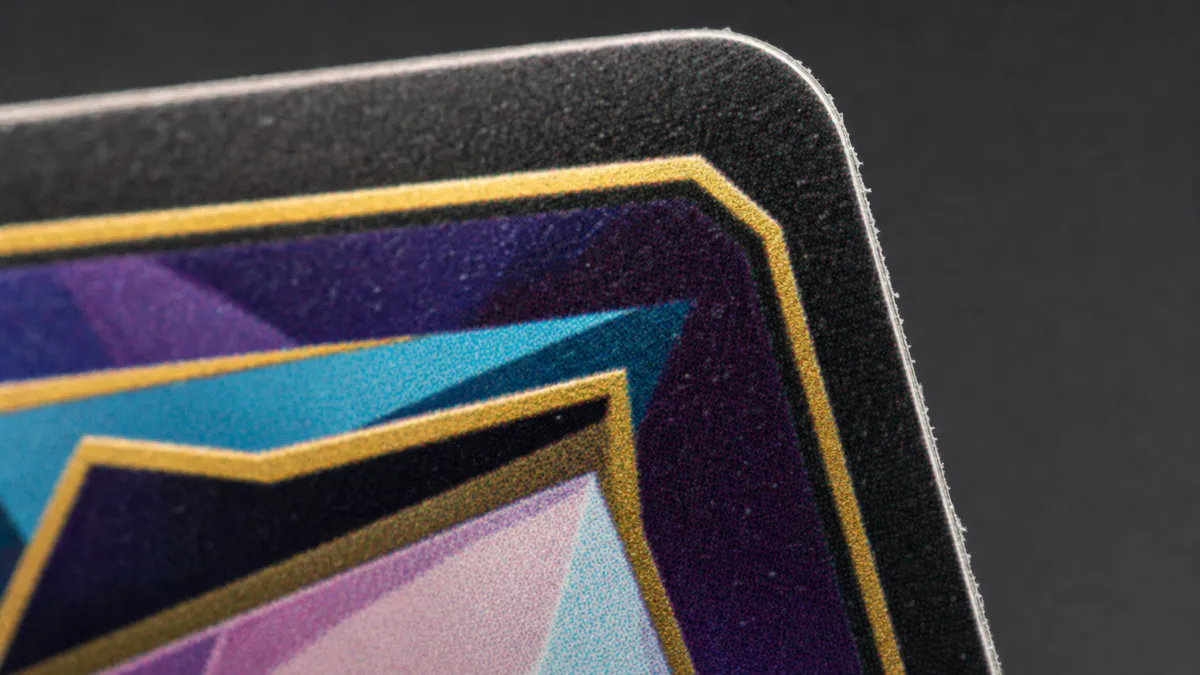 Replica
 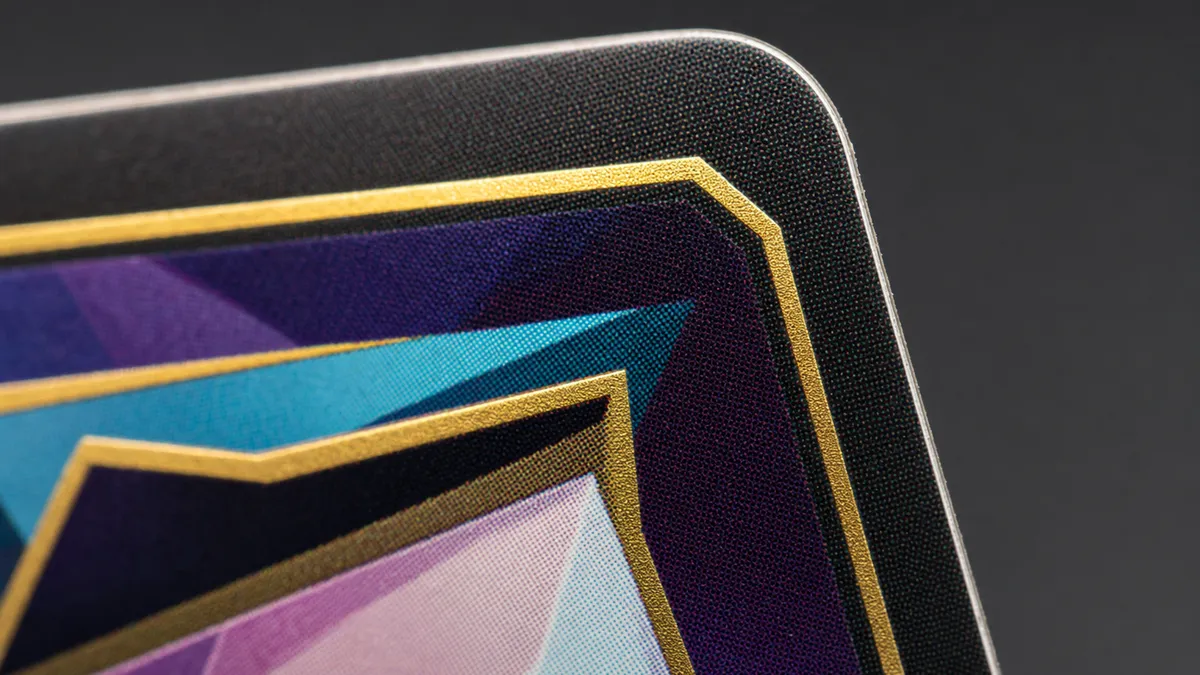 Authentic
 1. Print quality
Authentic: Under a loupe you see an even rosette of dots and clean color registration, with sharp text and no halo.
Fake: Blurry dots or a striped screen, misregistered colors, halos and re-scan artifacts around fine text.
2. Foil and prism effect on tilt
Authentic: A geometric refraction pattern matching the card's stated parallel (diagonal lines, waves, swirls and others on Prizm/Select/Optic; facets only on Mosaic's named parallels, with base cards possibly showing none) that shifts smoothly and coherently across the whole surface.
Fake: A grainy or oily film, a pattern blurred into a single line, one that breaks into patches, or one that is missing entirely where the stated parallel should show it.
3. Autographs
Authentic: A signature – on a sticker or written directly on the card, both official depending on the line and release – that matches documented examples of the same product in style and pen pressure.
Fake: A printed or stamped signature (a loupe shows print dots instead of an ink line), or a sticker that is lifting, shifted, or crookedly reapplied over a finished card.
4. Serial numbering
Authentic: A number – machine-printed or hand-written, both legitimate for the corresponding parallel – that matches the format and print-run range documented for that specific release.
Fake: A number whose format or font doesn't match the reference for that release, or one that exceeds the stated print run.
5. Cut, edges and fonts
Authentic: An even machine cut and sharp fine legal text on the back that matches the front typeface.
Fake: A ragged or "fuzzy" cut, blurry or wrong-weight fine print, and mismatched detail between front and back.
6. Sealed product and grading
Authentic: An even factory crimp on the wrapper with no signs of opening; a redemption card (a voucher in place of an autograph) is an official Panini product; on a slab, the cert number matches a recognized grading company's database.
Fake: Signs of resealing or re-taping the wrapper; on a slab, a cert number that isn't found in the grader's database or describes a different card.
Popular Panini models
Model-by-model checks – what to look at on each:
Where to inspect
The key zones to photograph and check on this type of item – a schematic, not a product photo.
- 1Corners and cut
- 2Centering
- 3Surface and gloss
- 4Edges and plies
- 5Print rosette
How to photograph your Panini for a check
Shoot in daylight, avoid glare, keep focus sharp. You need 5 angles:
- 1 Full card (front)
- 2 Print and foil close-up under a loupe and on tilt
- 3 Back and fine legal text close-up
- 4 Autograph or memorabilia patch close-up (if present)
- 5 Edges, cut and serial number
How to read the result
The AI returns a verdict with a confidence score:
- 75–100% – Authentic: high confidence the item is genuine.
- 60–74% – Likely authentic: probably genuine with minor concerns.
- 40–59% – Uncertain: the photos are not conclusive – retake or add angles.
- 25–39% – Likely fake: several red flags.
- 0–24% – Fake: clear signs of a replica.
Check your Panini right now
Snap photos of your item and get an AI verdict with a confidence score in about a minute.
FAQ
Is a sticker autograph on a Panini card fake?
No. Panini officially uses both sticker and on-card autographs across different lines and inserts – the type depends on the specific release, not on whether the card is genuine. The tell is a signature style and pen pressure that don't match documented examples of the same product, a printed or stamped imitation instead of real ink, or a sticker that is crookedly or freshly reapplied.
Is off-center printing or a print dot a fake tell?
Not on its own. Mild off-centering, print dots, or minor foil chipping at the edge occur on genuine cards straight from the factory and are a matter of condition and grade, not authenticity. They count as a fake tell only alongside print and foil issues.
Can I verify a Panini card by its serial number online?
There is no public "look up a Panini card by number" database – the printed number and barcode are copied literally by fakes. For high-value cards, the only reliable outside check is grading with a recognized company and matching the cert number in its online database.
Is a redemption card instead of an autograph normal?
Yes, a redemption card (a voucher later exchanged for the autographed card) is an official Panini product, not a fake. On its own it says nothing about the authenticity of the future autographed card – that comes down to seller trust and how the exchange plays out.