Guides · Trading Cards
How to Tell if Your Magic: The Gathering Card Is Real or Fake (2026)
Magic: The Gathering cards – from Black Lotus to dual lands – are one of the most faked corners of the collectible market, so any expensive copy is treated as counterfeit until proven otherwise. The verdict comes from the combination: the characteristic WotC offset rosette, exact typography, the back, and the card stock. The inner blue core is a supporting tell only – a foil card cannot be lit through, and modern blue-core counterfeits pass the test.
Real vs fake Magic: The Gathering: comparison table
Data current as of July 2026. Replicas evolve, so judge by the combination of signs – never a single one.
| Sign | Authentic | Fake |
|---|---|---|
| Blue core and the light test (supporting tell) | At the edge (cross-section) an inner blue layer sits between the two cardboard plies, and against the light the card is denser than a typical fake. It is a supporting tell only: a foil card cannot be lit through, some genuine misprints (Ixalan, for example) use different stock and fail the test, and modern blue-core counterfeits pass it. The verdict comes from the combination – rosette, fonts, back, stock. | No blue layer at the edge, and against the light the sheet is noticeably more translucent or a different stock – but draw conclusions together with the print rosette and typography. The rip test destroys the card, so use it last and only when you are willing to sacrifice the copy. |
| Rosette pattern under a loupe | On a colored area under a loupe, the print breaks into the WotC offset printing rosette of dots. | A linear dot row, an inkjet pixel grid, laser moiré, or blur instead of crisp dot rosettes. |
| Card stock and thickness (offline, not from a photo) | Thickness and stiffness that match a known-genuine card of the same era. This is an offline check: weight, stiffness, and sound cannot be judged from a photo, and there is no need to flex a collectible card – just hold it against a genuine one and compare thickness. | Stock that is too thin, mushy, or oddly "plastic"; delamination at the edge, a clear thickness difference against a genuine card of the same era. |
| Font and mana symbols | Exact title and text typography, correct mana symbol proportions and color, an even artist and copyright line. | A near-miss typeface, distorted or washed-out mana symbols, a shifted copyright, wandering letters. |
| Black border and corner rounding | An even, saturated black edge; Alpha corners are noticeably rounder than Beta/Unlimited – compare against the printing reference. Collectors’ and International Edition 1993 stand apart: genuine printings with square corners and a gold-bordered back. | Ink bleed at the edge, a corner radius that does not match the claimed printing. A crooked cut and an offset frame also occur on genuine cards (a matter of condition and grade), and edge whitening is ordinary wear: they count as fake tells only together with the print rosette and the card stock. |
| Deckmaster back and registration | The classic Deckmaster back: correct colors, crisp printing, an even black edge, and precise border alignment with the front. On double-faced cards (DFC/MDFC from Innistrad, Zendikar Rising) the back is a second front, so no Deckmaster art there is normal; Collectors’/International Edition 1993 backs carry a gold border and wording and are genuine too. | A front-to-back shift, dull colors, inconsistent tones, blurred art – typical signs of home printing. |
The difference is in the details – drag the slider
Typical differences in workmanship: stitching consistency, edge finishing, detail quality. Left – factory quality, right – common replica flaws.
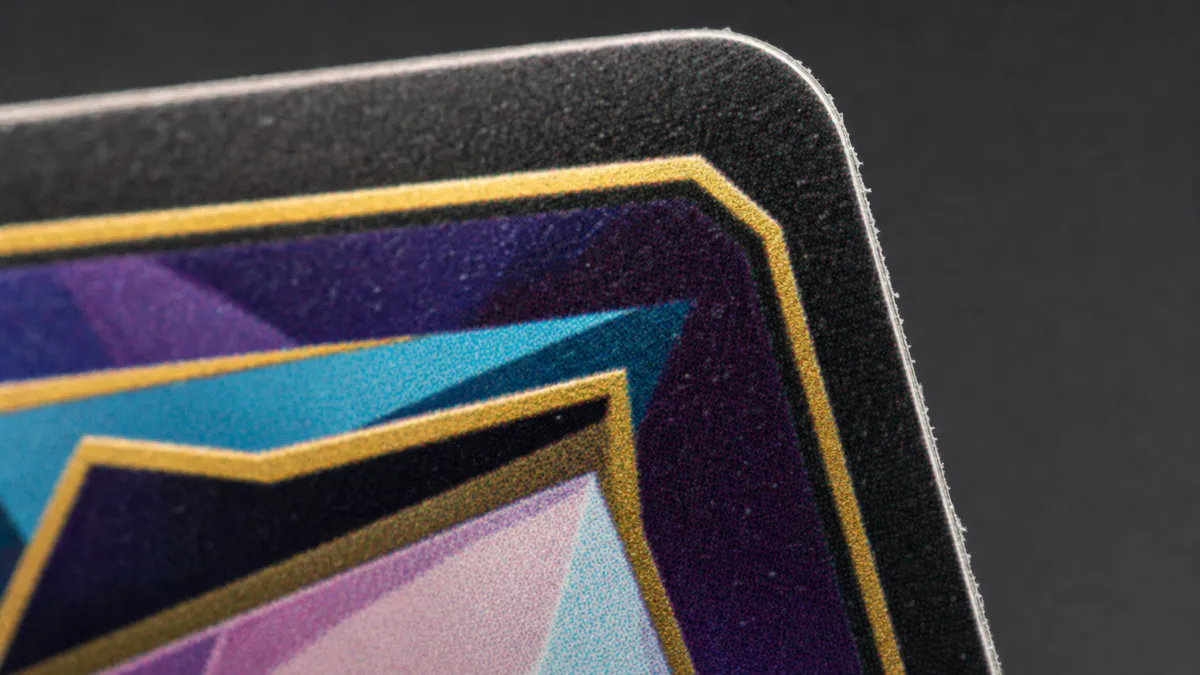 Replica
 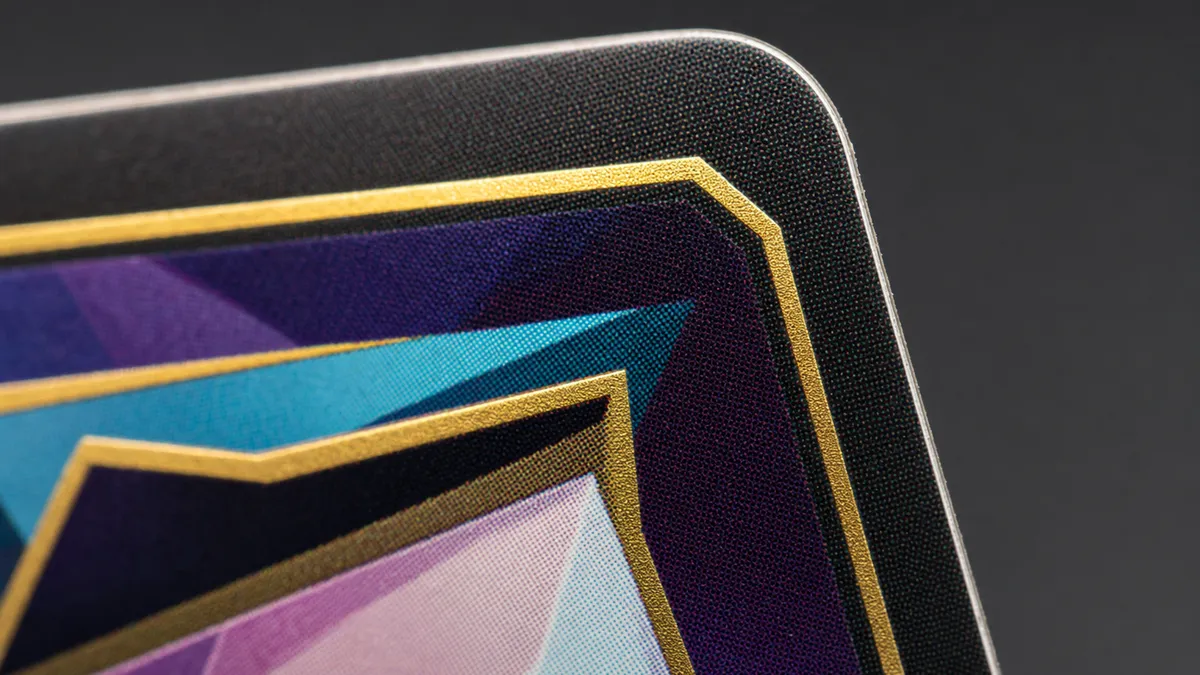 Authentic
 1. Blue core and the light test (supporting tell)
Authentic: At the edge (cross-section) an inner blue layer sits between the two cardboard plies, and against the light the card is denser than a typical fake. It is a supporting tell only: a foil card cannot be lit through, some genuine misprints (Ixalan, for example) use different stock and fail the test, and modern blue-core counterfeits pass it. The verdict comes from the combination – rosette, fonts, back, stock.
Fake: No blue layer at the edge, and against the light the sheet is noticeably more translucent or a different stock – but draw conclusions together with the print rosette and typography. The rip test destroys the card, so use it last and only when you are willing to sacrifice the copy.
2. Rosette pattern under a loupe
Authentic: On a colored area under a loupe, the print breaks into the WotC offset printing rosette of dots.
Fake: A linear dot row, an inkjet pixel grid, laser moiré, or blur instead of crisp dot rosettes.
3. Card stock and thickness (offline, not from a photo)
Authentic: Thickness and stiffness that match a known-genuine card of the same era. This is an offline check: weight, stiffness, and sound cannot be judged from a photo, and there is no need to flex a collectible card – just hold it against a genuine one and compare thickness.
Fake: Stock that is too thin, mushy, or oddly "plastic"; delamination at the edge, a clear thickness difference against a genuine card of the same era.
4. Font and mana symbols
Authentic: Exact title and text typography, correct mana symbol proportions and color, an even artist and copyright line.
Fake: A near-miss typeface, distorted or washed-out mana symbols, a shifted copyright, wandering letters.
5. Black border and corner rounding
Authentic: An even, saturated black edge; Alpha corners are noticeably rounder than Beta/Unlimited – compare against the printing reference. Collectors’ and International Edition 1993 stand apart: genuine printings with square corners and a gold-bordered back.
Fake: Ink bleed at the edge, a corner radius that does not match the claimed printing. A crooked cut and an offset frame also occur on genuine cards (a matter of condition and grade), and edge whitening is ordinary wear: they count as fake tells only together with the print rosette and the card stock.
6. Deckmaster back and registration
Authentic: The classic Deckmaster back: correct colors, crisp printing, an even black edge, and precise border alignment with the front. On double-faced cards (DFC/MDFC from Innistrad, Zendikar Rising) the back is a second front, so no Deckmaster art there is normal; Collectors’/International Edition 1993 backs carry a gold border and wording and are genuine too.
Fake: A front-to-back shift, dull colors, inconsistent tones, blurred art – typical signs of home printing.
Popular Magic: The Gathering models
Model-by-model checks – what to look at on each:
Where to inspect
The key zones to photograph and check on this type of item – a schematic, not a product photo.
- 1Corners and cut
- 2Centering
- 3Surface and gloss
- 4Edges and plies
- 5Print rosette
How to photograph your Magic: The Gathering for a check
Shoot in daylight, avoid glare, keep focus sharp. You need 5 angles:
- 1 Full card (front)
- 2 Edge/cross-section under light (blue core; the light test does not work on foils)
- 3 Rosette under a loupe on a colored area
- 4 Corners and black border close-up
- 5 Back (Deckmaster; a second front on double-faced cards)
How to read the result
The AI returns a verdict with a confidence score:
- 75–100% – Authentic: high confidence the item is genuine.
- 60–74% – Likely authentic: probably genuine with minor concerns.
- 40–59% – Uncertain: the photos are not conclusive – retake or add angles.
- 25–39% – Likely fake: several red flags.
- 0–24% – Fake: clear signs of a replica.
Check your Magic: The Gathering right now
Snap photos of your item and get an AI verdict with a confidence score in about a minute.
FAQ
What’s the most reliable Magic tell?
The combination decides: the print rosette under a loupe, the fonts, the back, and the stock. The blue cardboard layer is a supporting tell only – a foil card cannot be lit through, some genuine misprints (Ixalan, for example) use different stock and fail the test, and modern blue-core counterfeits pass it. The single most informative tell from a photo is the rosette: an offset dot rosette on the original, a pixel or inkjet grid on a fake. Just don’t damage the card with a forced bend – inspecting the edge under bright light is enough.
Can I rip the card to see the blue layer?
The rip test does reveal the blue core, but it destroys the card, so it is not a first step and usually unnecessary. The blue layer is visible non-destructively – at the edge or against the light on a slight flex. A tear is only justified for a clearly worthless copy, never for a valuable one.
How is Alpha different from Beta and Unlimited?
Alpha and Beta are black-bordered, while a white border means Unlimited or a later printing (Revised onwards). For the same card the main visual difference between Alpha and Beta is corner shape: Alpha corners are noticeably rounder, Beta corners are sharper (Beta also added two cards that Alpha did not have). Compare corner radius and border color against reference photos of the specific printing, and keep in mind Collectors’/International Edition 1993 – genuine printings with square corners.
How do I check the Power Nine and serialized cards?
The Power Nine are on the Reserved List and were printed in Alpha, Beta, and Unlimited, plus Collectors’/International Edition 1993 (square corners, a gold border and wording on the back) and 30th Anniversary Edition 2022 – genuine printings with different corners and backs, so verify each card against its own printing individually. Serialized cards carry a stamped serial number: judge the stamp quality and check the run size against the release’s official announcement.