Guides · Trading Cards
How to Tell if Your Pokémon Cards Are Real or Fake (2026)
Pokémon cards are one of the most counterfeited collectibles out there – from cheap AliExpress “proxies” to convincing replicas of grails like Charizard. The good news: almost every fake gives itself away on print quality, the cardboard core, and the typography. Every key tell is visible in a photo – with no destructive test required.
Real vs fake Pokémon: comparison table
Data current as of July 2026. Replicas evolve, so judge by the combination of signs – never a single one.
| Sign | Authentic | Fake |
|---|---|---|
| Print quality | Under a loupe you see an even rosette of dots, clean CMYK color registration, and sharp black text with no halo. | Blurry dots or a striped linear screen, misregistered colors, halos and re-scan artifacts around the lettering. |
| Card stock and the light test | There is a dark inner core between the cardboard layers: held to strong light the card stays opaque and doesn’t glow through. The test filters out crude fakes but is not conclusive on its own – the verdict comes from the combination of tells. | No core – the card glows through under light, and the stock is thinner or, conversely, glossier and more “plastic.” No destructive rip-or-bend test is needed; light shows whether the core is there. |
| Fonts and typography | The correct HP and name fonts, proper kerning, accurate energy symbols, and an even text box with the right color saturation. | Wrong or overly bold fonts, off kerning, distorted energy symbols, blown-out or washed color, a shifted text box. |
| Holo and foil | The signature holo/foil pattern with even shine and the correct effect type for the set; the foil catches light at the right angle. | A flat, oily, or grainy shine, the wrong holo type for the card, or foil where there shouldn’t be any. |
| Back and centering | A blue back with a crisp rosette and correct hues; front aligned to back, even centering and border, and a clean cut. | A pale or oversaturated back, or one misaligned to the front, an off-center or “eaten” border, and uneven edges and corners. |
| 1st Edition and set symbols | A correctly shaped and positioned 1st Edition stamp (sets after Neo Destiny never carried a 1st Edition stamp – its absence is normal); Base Set shadowless vs. unlimited told apart by the border shadow; sharp set symbol, copyright line, and card number. | A crooked or misplaced 1st Edition stamp, “fantasy” sets, a blurry symbol or number, and an unreadable copyright line. |
| Sealed products and slabs | Wrapper/box print is sharp and the factory crimp is clean; on a PSA/CGC slab the cert number matches the grader’s database. Not a photo check: pack weight can only be judged offline on a scale against a genuine pack of the same type (a few tenths of a gram of spread is normal). | Signs of resealing, a sloppy crimp; on a slab the cert number isn’t found in the database or doesn’t match the card. |
The difference is in the details – drag the slider
Typical differences in workmanship: stitching consistency, edge finishing, detail quality. Left – factory quality, right – common replica flaws.
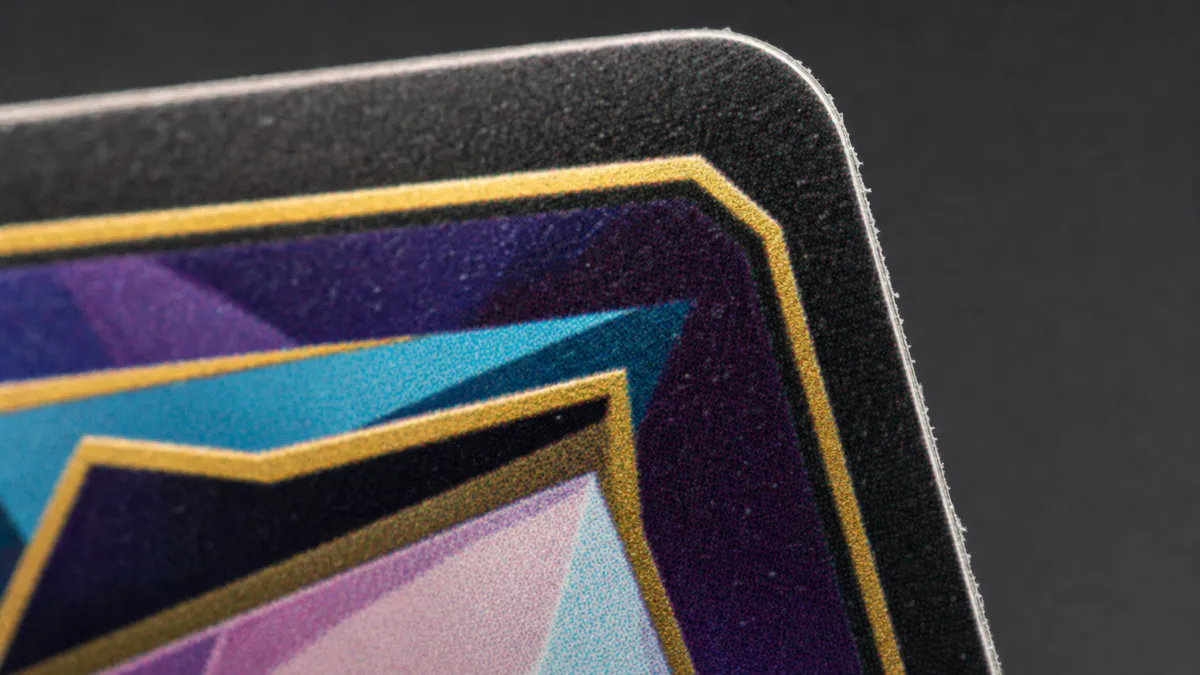 Replica
 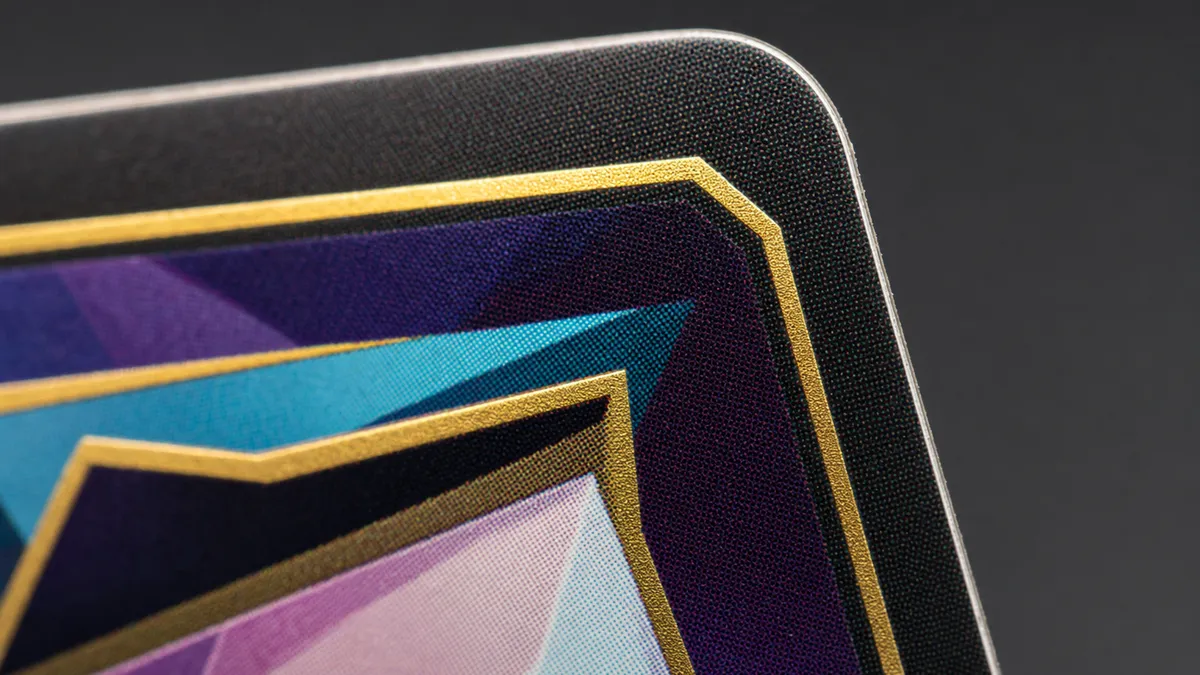 Authentic
 1. Print quality
Authentic: Under a loupe you see an even rosette of dots, clean CMYK color registration, and sharp black text with no halo.
Fake: Blurry dots or a striped linear screen, misregistered colors, halos and re-scan artifacts around the lettering.
2. Card stock and the light test
Authentic: There is a dark inner core between the cardboard layers: held to strong light the card stays opaque and doesn’t glow through. The test filters out crude fakes but is not conclusive on its own – the verdict comes from the combination of tells.
Fake: No core – the card glows through under light, and the stock is thinner or, conversely, glossier and more “plastic.” No destructive rip-or-bend test is needed; light shows whether the core is there.
3. Fonts and typography
Authentic: The correct HP and name fonts, proper kerning, accurate energy symbols, and an even text box with the right color saturation.
Fake: Wrong or overly bold fonts, off kerning, distorted energy symbols, blown-out or washed color, a shifted text box.
4. Holo and foil
Authentic: The signature holo/foil pattern with even shine and the correct effect type for the set; the foil catches light at the right angle.
Fake: A flat, oily, or grainy shine, the wrong holo type for the card, or foil where there shouldn’t be any.
5. Back and centering
Authentic: A blue back with a crisp rosette and correct hues; front aligned to back, even centering and border, and a clean cut.
Fake: A pale or oversaturated back, or one misaligned to the front, an off-center or “eaten” border, and uneven edges and corners.
6. 1st Edition and set symbols
Authentic: A correctly shaped and positioned 1st Edition stamp (sets after Neo Destiny never carried a 1st Edition stamp – its absence is normal); Base Set shadowless vs. unlimited told apart by the border shadow; sharp set symbol, copyright line, and card number.
Fake: A crooked or misplaced 1st Edition stamp, “fantasy” sets, a blurry symbol or number, and an unreadable copyright line.
7. Sealed products and slabs
Authentic: Wrapper/box print is sharp and the factory crimp is clean; on a PSA/CGC slab the cert number matches the grader’s database. Not a photo check: pack weight can only be judged offline on a scale against a genuine pack of the same type (a few tenths of a gram of spread is normal).
Fake: Signs of resealing, a sloppy crimp; on a slab the cert number isn’t found in the database or doesn’t match the card.
Popular Pokémon models
Model-by-model checks – what to look at on each:
Where to inspect
The key zones to photograph and check on this type of item – a schematic, not a product photo.
- 1Corners and cut
- 2Centering
- 3Surface and gloss
- 4Edges and plies
- 5Print rosette
How to photograph your Pokémon for a check
Shoot in daylight, avoid glare, keep focus sharp. You need 5 angles:
- 1 Full card (front)
- 2 Print close-up under a loupe
- 3 Card held to light (dark core)
- 4 Back and centering
- 5 Set symbol, card number and – for Base–Neo sets (pre-2002) – the 1st Edition stamp
How to read the result
The AI returns a verdict with a confidence score:
- 75–100% – Authentic: high confidence the item is genuine.
- 60–74% – Likely authentic: probably genuine with minor concerns.
- 40–59% – Uncertain: the photos are not conclusive – retake or add angles.
- 25–39% – Likely fake: several red flags.
- 0–24% – Fake: clear signs of a replica.
Check your Pokémon right now
Snap photos of your item and get an AI verdict with a confidence score in about a minute.
FAQ
What is the “light test,” and will it damage the card?
It’s a non-destructive test: you hold the card up to a strong light source. A genuine card has a dark inner core between its cardboard layers, so it won’t glow through. You never need to bend, rip, or soak the card – the light alone reveals whether the core is there. The test filters out crude fakes but is not conclusive: the verdict comes from print, fonts, holo, and the back together.
Which cards get faked the most?
The grails cost the most to fake: Base Set Charizard and especially the 1st Edition, along with high-value alt arts from modern sets. The higher the price, the more sophisticated the replica. For grails it’s smart to assume “fake until proven otherwise” and only buy them in a PSA/CGC slab with a verifiable cert.
How do I verify a PSA or CGC graded slab?
The slab carries a cert number – look it up in the grader’s online database (PSA/CGC). The record must match the card in the slab: name, set, number, and grade. If the cert isn’t found or describes a different card, the slab has been swapped or forged.
Is a single photo enough for a verdict?
One strongest tell – the print under a loupe or the core under light – helps, but a reliable call comes from the combination: print + core + fonts + holo + back. The app tells you which angles to shoot and will honestly flag “uncertain” if there aren’t enough shots.