Guides · Trading Cards
How to Tell if Your Topps Cards Are Real or Fake (2026)
Topps cards get faked just as aggressively as Pokémon – from crude proxies to convincing replicas of pricey chrome and autograph cards. Almost every fake gives itself away on print quality, the card stock, and how the foil behaves under light. Here are the visual tells you can judge from a photo, without tying anything to a specific season, set, or card number.
Real vs fake NBA Topps: comparison table
Data current as of July 2026. Replicas evolve, so judge by the combination of signs – never a single one.
| Sign | Authentic | Fake |
|---|---|---|
| Halftone print | Under magnification the halftone pattern is crisp and even, with tight color registration and sharp fine text with no halo or blur. | Blurry or “stair-stepped” dots, misregistered colors, halos around text, or visible re-scan artifacts and pixelation. |
| Foil and chrome behavior | Tilted under a light source, the chrome layer or foil shifts shine evenly and predictably, with the pattern reading clearly at different angles. | A flat, oily, or grainy shine; a foil pattern that’s blurry or missing; no change in the effect as the card is tilted. |
| Card stock thickness and stiffness | The stock is dense and appropriately stiff, noticeably thicker than ordinary paper; it visibly reads as a multi-layer material rather than a thin sheet. | Stock that’s noticeably thinner or, conversely, too flexible and “plasticky,” looking more like glossy paper than genuine card stock. |
| Cut edge | The cut edge is clean and dense, with no separation into individual paper layers and no fuzzy or fibrous texture along the border. | Visible layering of the cardboard at the cut, a loose or fuzzy edge, and an uneven, wavy cut line. |
| Fine-text sharpness and font match | Fine text on the back (copyright line, stats, card number) is sharp and legible, and the font style matches visually between the front and back. | Blurry, “soupy,” or pixelated fine text, or a back-side font that visibly differs in style from the front. |
| Gloss coating quality | The gloss coating is even across the whole surface, with no bare patches, streaks, or bubbles, and a uniform shine. | Patchy or streaky gloss, bare uncoated spots, bubbling, or gloss lifting at the edges. |
The difference is in the details – drag the slider
Typical differences in workmanship: stitching consistency, edge finishing, detail quality. Left – factory quality, right – common replica flaws.
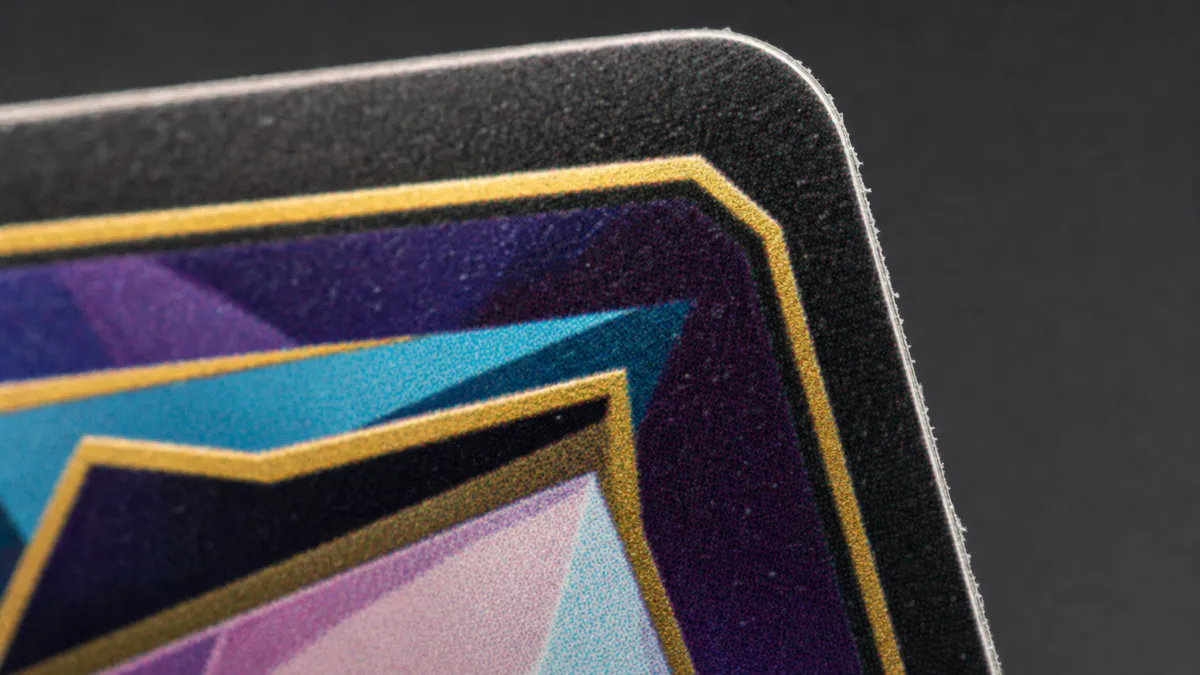 Replica
 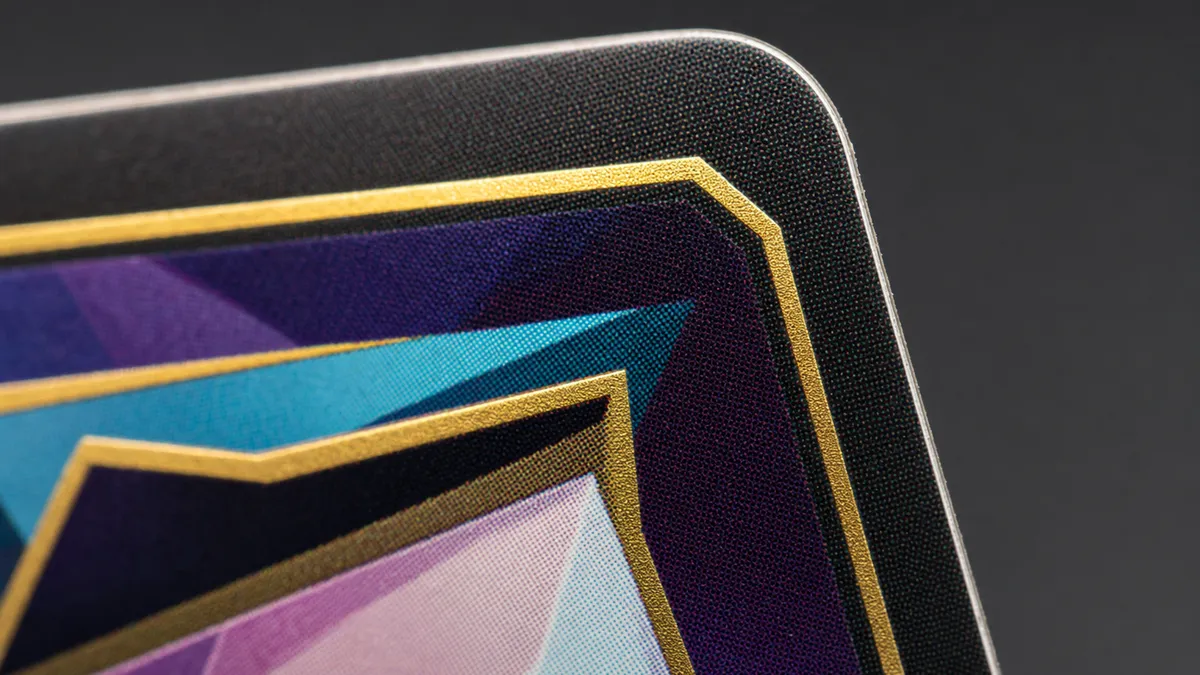 Authentic
 1. Halftone print
Authentic: Under magnification the halftone pattern is crisp and even, with tight color registration and sharp fine text with no halo or blur.
Fake: Blurry or “stair-stepped” dots, misregistered colors, halos around text, or visible re-scan artifacts and pixelation.
2. Foil and chrome behavior
Authentic: Tilted under a light source, the chrome layer or foil shifts shine evenly and predictably, with the pattern reading clearly at different angles.
Fake: A flat, oily, or grainy shine; a foil pattern that’s blurry or missing; no change in the effect as the card is tilted.
3. Card stock thickness and stiffness
Authentic: The stock is dense and appropriately stiff, noticeably thicker than ordinary paper; it visibly reads as a multi-layer material rather than a thin sheet.
Fake: Stock that’s noticeably thinner or, conversely, too flexible and “plasticky,” looking more like glossy paper than genuine card stock.
4. Cut edge
Authentic: The cut edge is clean and dense, with no separation into individual paper layers and no fuzzy or fibrous texture along the border.
Fake: Visible layering of the cardboard at the cut, a loose or fuzzy edge, and an uneven, wavy cut line.
5. Fine-text sharpness and font match
Authentic: Fine text on the back (copyright line, stats, card number) is sharp and legible, and the font style matches visually between the front and back.
Fake: Blurry, “soupy,” or pixelated fine text, or a back-side font that visibly differs in style from the front.
6. Gloss coating quality
Authentic: The gloss coating is even across the whole surface, with no bare patches, streaks, or bubbles, and a uniform shine.
Fake: Patchy or streaky gloss, bare uncoated spots, bubbling, or gloss lifting at the edges.
Where to inspect
The key zones to photograph and check on this type of item – a schematic, not a product photo.
- 1Corners and cut
- 2Centering
- 3Surface and gloss
- 4Edges and plies
- 5Print rosette
How to photograph your NBA Topps for a check
Shoot in daylight, avoid glare, keep focus sharp. You need 5 angles:
- 1 Full card (front)
- 2 Print close-up under magnification
- 3 Card tilted toward light (foil/chrome)
- 4 Close-up of the cut edge
- 5 Back of the card with fine text
How to read the result
The AI returns a verdict with a confidence score:
- 75–100% – Authentic: high confidence the item is genuine.
- 60–74% – Likely authentic: probably genuine with minor concerns.
- 40–59% – Uncertain: the photos are not conclusive – retake or add angles.
- 25–39% – Likely fake: several red flags.
- 0–24% – Fake: clear signs of a replica.
Check your NBA Topps right now
Snap photos of your item and get an AI verdict with a confidence score in about a minute.
FAQ
The card has off-center printing or a print dot – is that a fake?
No. Off-center printing, small print dots, a minor foil chip at the edge, or a slight miscut are factory print quirks that also occur on genuine cards. On their own they aren’t a sign of a fake – what matters is the print structure, foil behavior, card stock, and cut edge.
Can I verify a card by a number or the barcode on the pack?
There is no public database for checking a Topps card by number, and a barcode on packaging is copied literally by replicas, so it proves nothing on its own. The only reliable outside anchor is grading by a recognized grading company with a verifiable certificate.
Should I bend the card to test how flexible the stock is?
No, don’t. Bending is a destructive test that can damage a collectible card, including a genuine one. You can judge the stock’s thickness, stiffness, and cut edge visually from a photo without bending the card at all.
Is a single photo enough for a verdict?
One strong tell – the print under magnification or how the foil behaves – helps, but a reliable call comes from the combination: print, foil, stock, cut edge, text, and gloss together. The app will tell you which angles to shoot and will honestly flag the result as “uncertain” if there aren’t enough photos.