Guides · Luxury Handbags
How to Authenticate a Loewe Bag: Real vs Fake (2026)
Loewe is a Spanish leather house founded in 1846 and now part of LVMH: leather was its specialty long before the logo era, and leather is what every authentication of a Loewe bag rests on. The Puzzle, Hammock, Gate, Flamenco, and Basket – house icons shaped or relaunched in the Jonathan Anderson era – are counterfeited at scale, but replicas consistently fail on three fronts: lively soft leather, precise embossing of the four-mirrored-L Anagram, and construction accuracy, whether it’s the Puzzle’s panel joints or the knot on a Gate’s flap. Here’s what to check and in what order.
Real vs fake Loewe: comparison table
Data current as of July 2026. Replicas evolve, so judge by the combination of signs – never a single one.
| Sign | Authentic | Fake |
|---|---|---|
| Leather quality | Soft-looking leather with a natural, lively grain that never repeats from panel to panel; it looks dense and “filled,” and on soft models falls in a heavy, fluid drape. | Stiff or thin, lifeless leather, a uniform stamped grain with a repeating pattern, a chemical smell; soft models fail to fall into the right folds. |
| Anagram embossing | The four mirrored L’s are embossed deeply and crisply: equal element weight, identical gaps, strict mirroring on both axes. | A shallow or blurry impression, a squashed or stretched figure, elements of varying weight, broken mirroring – an Anagram that’s “almost right” but doesn’t match reference. |
| Construction and panel alignment | Puzzle panel joints meet precisely and the facets form symmetrical geometry; Gate and Flamenco flaps sit flush, and the silhouette matches release references. | Drifting joints, uneven corners, mismatched panel sizes left to right, a skewed flap – precise cutting demands manufacturing that replica factories don’t have. |
| Hardware | The metal has clean, even plating with no bubbling, engravings are crisp and deep, zipper teeth are even end to end, and snaps and clasps sit flush with no visible gap. | Thin, stamped-looking hardware with a rough edge, small mushy engraving, chipped zipper teeth, a visible gap in locks and clasps. |
| Stitching and edge paint | Even stitching with consistent pitch, even on curves; leather edges painted neatly, with an unbroken paint line and no drips or gaps. | Wandering stitch pitch, seams that pucker soft leather and wrinkle the panel; edge paint with drips, skips, or an uneven line. |
| Interior stamps and labels | Embossed stamps and labels with crisp lettering, sewn in neatly; the marking set matches documented references for the specific release; the country of origin is plausible – often Spain. | Faint or crooked embossing, labels with errors and smudged printing, a stamp set that doesn’t match release references. |
The difference is in the details – drag the slider
Typical differences in workmanship: stitching consistency, edge finishing, detail quality. Left – factory quality, right – common replica flaws.
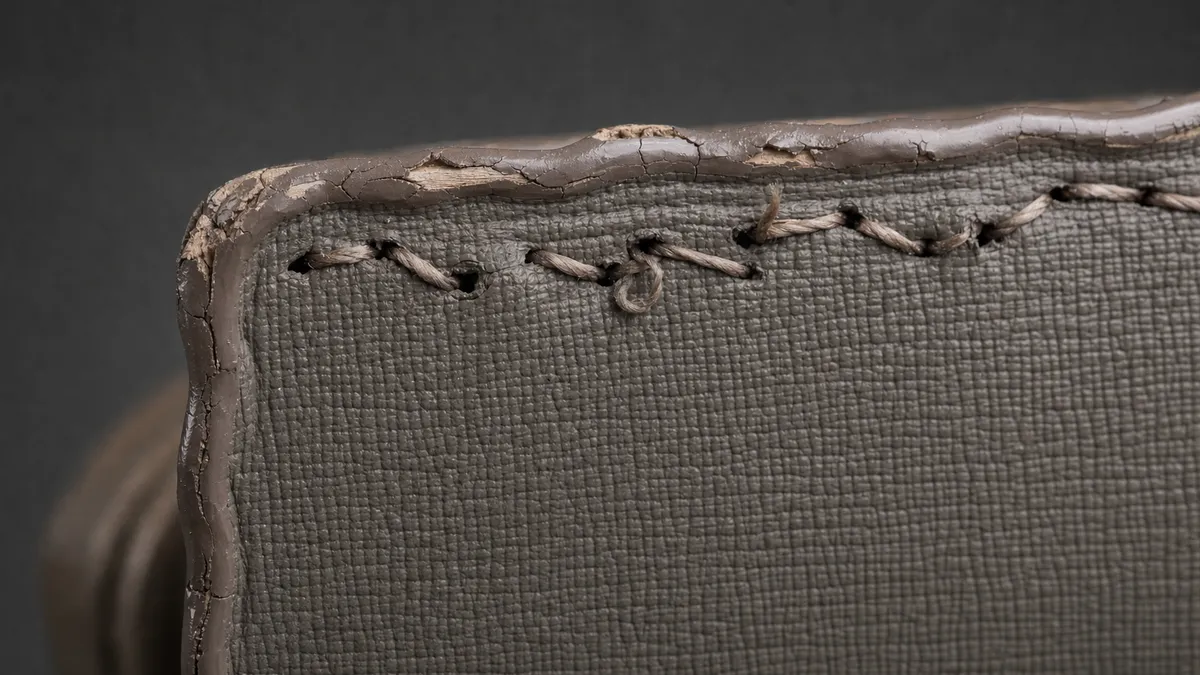 Replica
 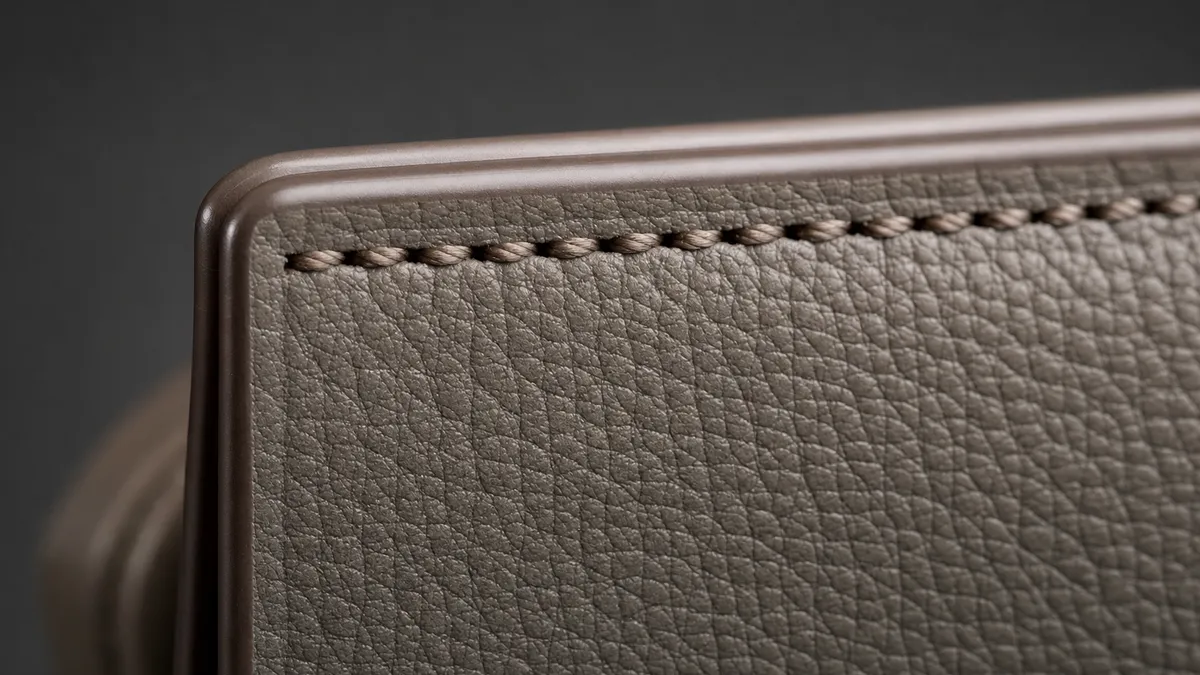 Authentic
 1. Leather quality
Authentic: Soft-looking leather with a natural, lively grain that never repeats from panel to panel; it looks dense and “filled,” and on soft models falls in a heavy, fluid drape.
Fake: Stiff or thin, lifeless leather, a uniform stamped grain with a repeating pattern, a chemical smell; soft models fail to fall into the right folds.
2. Anagram embossing
Authentic: The four mirrored L’s are embossed deeply and crisply: equal element weight, identical gaps, strict mirroring on both axes.
Fake: A shallow or blurry impression, a squashed or stretched figure, elements of varying weight, broken mirroring – an Anagram that’s “almost right” but doesn’t match reference.
3. Construction and panel alignment
Authentic: Puzzle panel joints meet precisely and the facets form symmetrical geometry; Gate and Flamenco flaps sit flush, and the silhouette matches release references.
Fake: Drifting joints, uneven corners, mismatched panel sizes left to right, a skewed flap – precise cutting demands manufacturing that replica factories don’t have.
4. Hardware
Authentic: The metal has clean, even plating with no bubbling, engravings are crisp and deep, zipper teeth are even end to end, and snaps and clasps sit flush with no visible gap.
Fake: Thin, stamped-looking hardware with a rough edge, small mushy engraving, chipped zipper teeth, a visible gap in locks and clasps.
5. Stitching and edge paint
Authentic: Even stitching with consistent pitch, even on curves; leather edges painted neatly, with an unbroken paint line and no drips or gaps.
Fake: Wandering stitch pitch, seams that pucker soft leather and wrinkle the panel; edge paint with drips, skips, or an uneven line.
6. Interior stamps and labels
Authentic: Embossed stamps and labels with crisp lettering, sewn in neatly; the marking set matches documented references for the specific release; the country of origin is plausible – often Spain.
Fake: Faint or crooked embossing, labels with errors and smudged printing, a stamp set that doesn’t match release references.
Popular Loewe models
Model-by-model checks – what to look at on each:
Where to inspect
The key zones to photograph and check on this type of item – a schematic, not a product photo.
- 1Logo and hardware
- 2Handle attachment
- 3Stitching and edges
- 4Date code and tag
- 5Zipper and base
How to photograph your Loewe for a check
Shoot in daylight, avoid glare, keep focus sharp. You need 5 angles:
- 1 Full bag (front)
- 2 Embossed Anagram or LOEWE wordmark close-up
- 3 Hardware and engravings
- 4 Interior stamps and labels
- 5 Stitching, edges, and panel joints
How to read the result
The AI returns a verdict with a confidence score:
- 75–100% – Authentic: high confidence the item is genuine.
- 60–74% – Likely authentic: probably genuine with minor concerns.
- 40–59% – Uncertain: the photos are not conclusive – retake or add angles.
- 25–39% – Likely fake: several red flags.
- 0–24% – Fake: clear signs of a replica.
Check your Loewe right now
Snap photos of your item and get an AI verdict with a confidence score in about a minute.
FAQ
What’s the fastest Loewe bag tell?
The “leather + Anagram” pair. The leather must be soft with a natural, non-repeating grain, and the Anagram embossing must be deep, with the exact geometry of four mirrored L’s. Replicas almost always fail at least one of those two checks; on a Puzzle, panel alignment is the third quick test.
Can I authenticate a Loewe bag by its serial number?
Loewe uses interior labels and stamps, but there is no public database to “run” a number through, and no honest service will offer one. The right approach is to match the set of stamps and labels against documented references for the specific release and call the verdict on the full set of tells.
Are Loewe bags made only in Spain?
Loewe is a Spanish house and production often is Spanish, but don’t lean on a single country stamp: on its own it proves nothing and is trivial to fake. Weigh the country of origin together with the rest of the tells – leather, embossing, construction, and hardware.
Is a photo of the Anagram enough for a verdict?
The Anagram is the strongest single signal, but a reliable verdict comes from the combination: embossing geometry + leather quality + construction accuracy + hardware and stamps. The app tells you which angles to shoot for the specific model and cross-references the bag against release references.