Guides · Luxury Handbags
How to Authenticate a Givenchy Bag: Real vs Fake (2026)
Givenchy is a French fashion house within LVMH, and its flagship – the structured Antigona – is one of the most counterfeited luxury bags out there. Authenticating most Givenchy models rests on three things: the geometry and stiffness of the silhouette (especially the Antigona’s winged trapeze), the crispness of the embossed “GIVENCHY PARIS” wordmark and the “4G” motif, and the quality of the leather and the polish of the hardware. The soft models – the Pandora and the Nightingale – are checked differently: there, proper asymmetry and natural drape matter most. Here’s what to look at and in what order – carefully, as tells rather than guarantees.
Real vs fake Givenchy: comparison table
Data current as of July 2026. Replicas evolve, so judge by the combination of signs – never a single one.
| Sign | Authentic | Fake |
|---|---|---|
| Silhouette geometry and symmetry | On structured models (the Antigona) the trapeze is symmetrical around the center, the wings are even and matched, the corners tidy, and the body holds its shape on its own. On soft models (the Pandora) the asymmetry reads deliberate rather than accidental. | Skewed geometry, mismatched wing shapes, crooked corners; a soft, slumping frame that has lost its structure. On soft models, a sloppy imbalance instead of a deliberate asymmetry. |
| Logo embossing | The embossed “GIVENCHY PARIS” and the “4G” motif use an even, crisp font: correct spacing between letters, clean outlines, and a deep, tidy impression. | A crooked, smudged, or condensed font, drifting letter spacing, a mushy or skewed impression – a logo that’s “almost right” but doesn’t match reference. |
| Leather quality | Dense, quality leather (often calf or goat), grained or smooth, with an even tone and a natural texture; on soft models, a lively drape falling into fluid folds. | Stiff or thin, lifeless leather, a plasticky sheen, a chemical smell; soft models fail to fall into the right natural folds. |
| Hardware and zipper | The metal has clean, even plating with no bubbling, engravings are crisp and deep; a quality branded zipper has even, undamaged teeth end to end, and locks and clasps sit flush with no visible gap. | Thin, stamped-looking hardware with a rough edge, small mushy engraving, chipped or uneven zipper teeth, a visible gap in locks; on the GV3, a crooked or imprecisely seated turn-lock. |
| Stitching and edges | Even stitching with consistent pitch, even on curves and corners; leather edges painted neatly, with an unbroken paint line and no drips or gaps. | Wandering stitch pitch, seams that pucker soft leather and wrinkle the panel; sloppy corners, edge paint with drips, skips, or an uneven line. |
| Interior stamps and labels | Embossed stamps and labels with crisp lettering, sewn in neatly; the marking set matches documented references for the specific release; the country of origin is plausible – often Italy. | Faint or crooked embossing, labels with errors and smudged printing, a stamp set that doesn’t match release references. |
The difference is in the details – drag the slider
Typical differences in workmanship: stitching consistency, edge finishing, detail quality. Left – factory quality, right – common replica flaws.
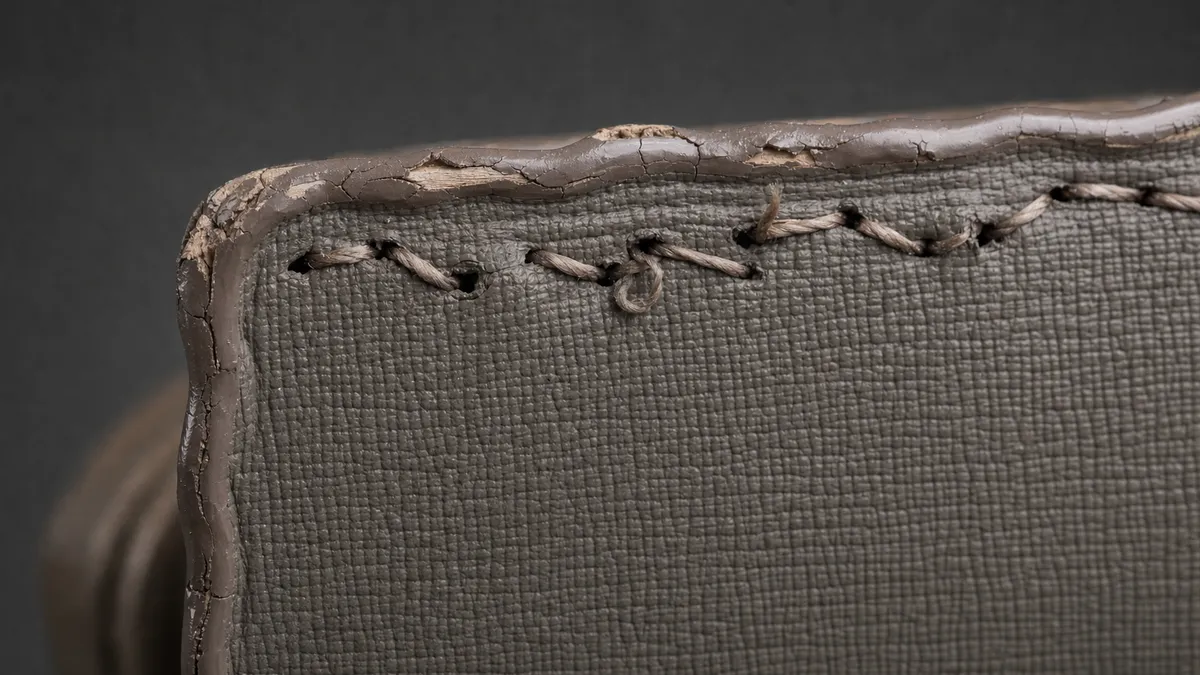 Replica
 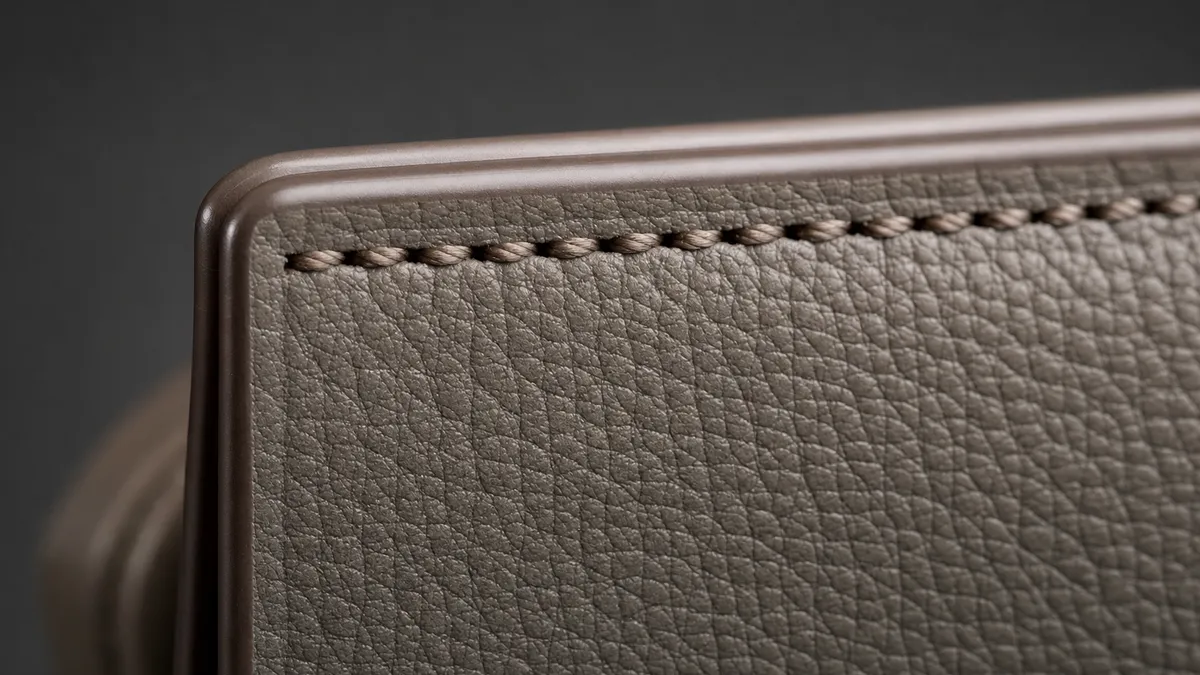 Authentic
 1. Silhouette geometry and symmetry
Authentic: On structured models (the Antigona) the trapeze is symmetrical around the center, the wings are even and matched, the corners tidy, and the body holds its shape on its own. On soft models (the Pandora) the asymmetry reads deliberate rather than accidental.
Fake: Skewed geometry, mismatched wing shapes, crooked corners; a soft, slumping frame that has lost its structure. On soft models, a sloppy imbalance instead of a deliberate asymmetry.
2. Logo embossing
Authentic: The embossed “GIVENCHY PARIS” and the “4G” motif use an even, crisp font: correct spacing between letters, clean outlines, and a deep, tidy impression.
Fake: A crooked, smudged, or condensed font, drifting letter spacing, a mushy or skewed impression – a logo that’s “almost right” but doesn’t match reference.
3. Leather quality
Authentic: Dense, quality leather (often calf or goat), grained or smooth, with an even tone and a natural texture; on soft models, a lively drape falling into fluid folds.
Fake: Stiff or thin, lifeless leather, a plasticky sheen, a chemical smell; soft models fail to fall into the right natural folds.
4. Hardware and zipper
Authentic: The metal has clean, even plating with no bubbling, engravings are crisp and deep; a quality branded zipper has even, undamaged teeth end to end, and locks and clasps sit flush with no visible gap.
Fake: Thin, stamped-looking hardware with a rough edge, small mushy engraving, chipped or uneven zipper teeth, a visible gap in locks; on the GV3, a crooked or imprecisely seated turn-lock.
5. Stitching and edges
Authentic: Even stitching with consistent pitch, even on curves and corners; leather edges painted neatly, with an unbroken paint line and no drips or gaps.
Fake: Wandering stitch pitch, seams that pucker soft leather and wrinkle the panel; sloppy corners, edge paint with drips, skips, or an uneven line.
6. Interior stamps and labels
Authentic: Embossed stamps and labels with crisp lettering, sewn in neatly; the marking set matches documented references for the specific release; the country of origin is plausible – often Italy.
Fake: Faint or crooked embossing, labels with errors and smudged printing, a stamp set that doesn’t match release references.
Popular Givenchy models
Model-by-model checks – what to look at on each:
Where to inspect
The key zones to photograph and check on this type of item – a schematic, not a product photo.
- 1Logo and hardware
- 2Handle attachment
- 3Stitching and edges
- 4Date code and tag
- 5Zipper and base
How to photograph your Givenchy for a check
Shoot in daylight, avoid glare, keep focus sharp. You need 5 angles:
- 1 Full bag (front)
- 2 Embossed “GIVENCHY PARIS” or “4G” logo close-up
- 3 Hardware, zipper, and engravings
- 4 Interior stamps and labels
- 5 Stitching, edges, and corners
How to read the result
The AI returns a verdict with a confidence score:
- 75–100% – Authentic: high confidence the item is genuine.
- 60–74% – Likely authentic: probably genuine with minor concerns.
- 40–59% – Uncertain: the photos are not conclusive – retake or add angles.
- 25–39% – Likely fake: several red flags.
- 0–24% – Fake: clear signs of a replica.
Check your Givenchy right now
Snap photos of your item and get an AI verdict with a confidence score in about a minute.
FAQ
What’s the fastest Givenchy bag tell?
For the Antigona, the “geometry + stiffness” pair: symmetrical wings, tidy corners, and a body that holds its structured shape. For the soft models (Pandora, Nightingale), leather quality and a proper drape come first. The second-most-important tell is almost always the crispness of the embossed “GIVENCHY PARIS” wordmark.
How can I tell a real Givenchy from a fake by the logo?
On an authentic bag the embossed “GIVENCHY PARIS” and the “4G” motif use an even, crisp font with correct spacing and clean outlines. A crooked, smudged, or condensed impression with drifting letter spacing is a strong fake sign – but confirm it together with the silhouette geometry, leather, and hardware.
Can I check Givenchy authenticity by a serial number?
Givenchy has no public serial-number database to “run” a number through, and no honest service will offer one. The right approach is to match the set of interior stamps and labels against documented references for the specific release and call the verdict on the full set of tells.
Is a photo of the logo enough for a verdict?
Logo embossing is a strong single signal, but a reliable verdict comes from the combination: silhouette geometry and stiffness + leather quality + hardware + interior stamps. The app tells you which angles to shoot for the specific model and cross-references the bag against documented release references.