Guides · Luxury Handbags
How to Authenticate a Goyard Bag: Real vs Fake (2026)
Goyard is a French house dating to 1853 and famously secretive: it has no online store, no public serial-number database, and no official online authentication. Every check rests on the house’s Goyardine canvas – a Y-shaped chevron pattern historically hand-applied through a stencil onto a layered, calendered canvas rather than printed as a flat image. Replicas consistently fail on three fronts: chevron crispness and alignment, the hand-painted edges, and embossing accuracy. Here’s what to check and in what order – the tone stays cautious, because there is nowhere to “run a Goyard number.”
Real vs fake Goyard: comparison table
Data current as of July 2026. Replicas evolve, so judge by the combination of signs – never a single one.
| Sign | Authentic | Fake |
|---|---|---|
| Goyardine pattern and chevron | A crisp Y-shaped herringbone design at the correct scale with exact color registration; the diamond structure reads evenly and the lines don’t drift. | A blurry or crooked pattern, wrong chevron scale, off color registration – the design looks printed rather than stenciled onto a dense canvas. |
| Pattern alignment at seams | The chevron continues logically across side seams and panel joints: the design doesn’t break off, and the lines meet consistently. | At the joints the pattern breaks off or runs out of step; replica factories cut without regard for the design and don’t align the chevron. |
| Hand-painted edges | The leather edges and piping are hand-painted in a neat, unbroken line around the entire perimeter, with no drips or gaps. | An uneven paint line with drips, skips, or bleed onto the canvas; the edges are painted sloppily. |
| Embossing and address stamp | The “GOYARD” embossing and the maison’s address stamp (a house since 1853) use a crisp, even typeface with exact geometry; the wording matches release references. | A faint, crooked, or mushy impression, the wrong typeface or spacing, spelling errors in the stamp. |
| Canvas, hardware, and lining | The canvas looks matte and dense, with no glossy plasticky sheen, and the chevron weave texture is visible; the hardware has clean, even engraving with no bubbling, zipper teeth are even, and the lining is neatly sewn in. | A glossy, plasticky-looking material with a rubbery sheen, or a limp material; thin, stamped-looking hardware with a rough edge, mushy engraving, chipped zipper teeth, a sloppy lining. |
| Hand-painted personalization | If painted initials are present (Goyard is known for hand-painted monograms), the lines are even and confident, the paint sits neatly, and the letter geometry is deliberate. | Shaky or uneven painted lines, bleeding paint, crooked letter geometry – an imitation of the hand personalization. |
The difference is in the details – drag the slider
Typical differences in workmanship: stitching consistency, edge finishing, detail quality. Left – factory quality, right – common replica flaws.
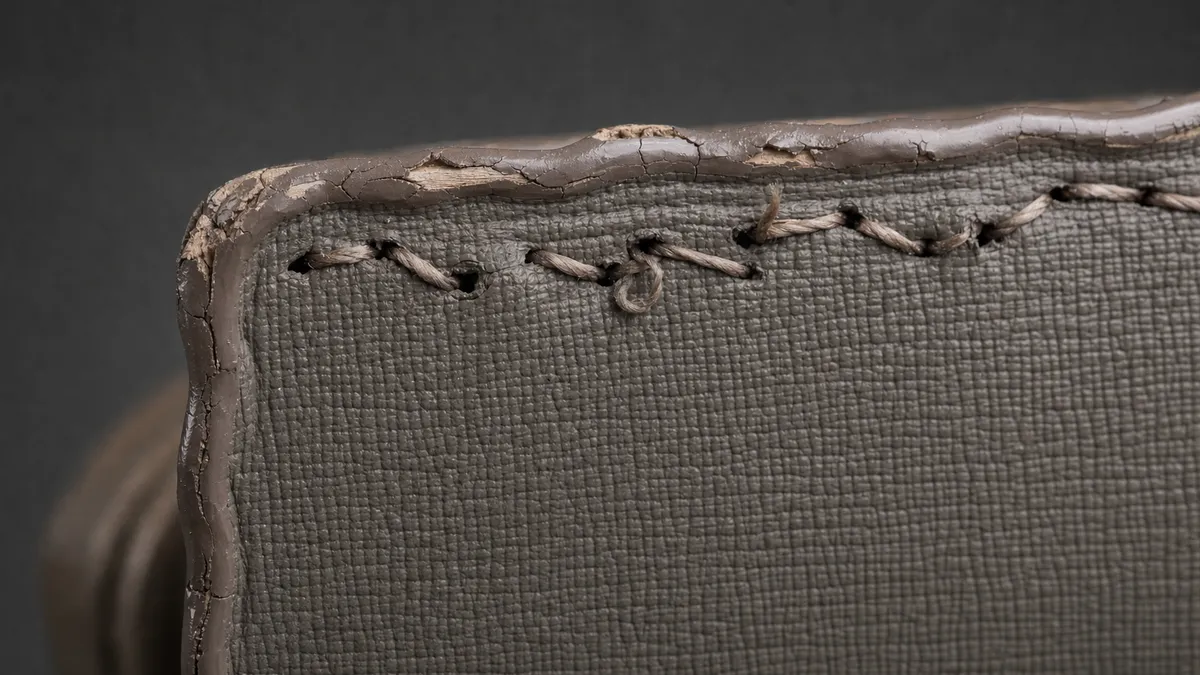 Replica
 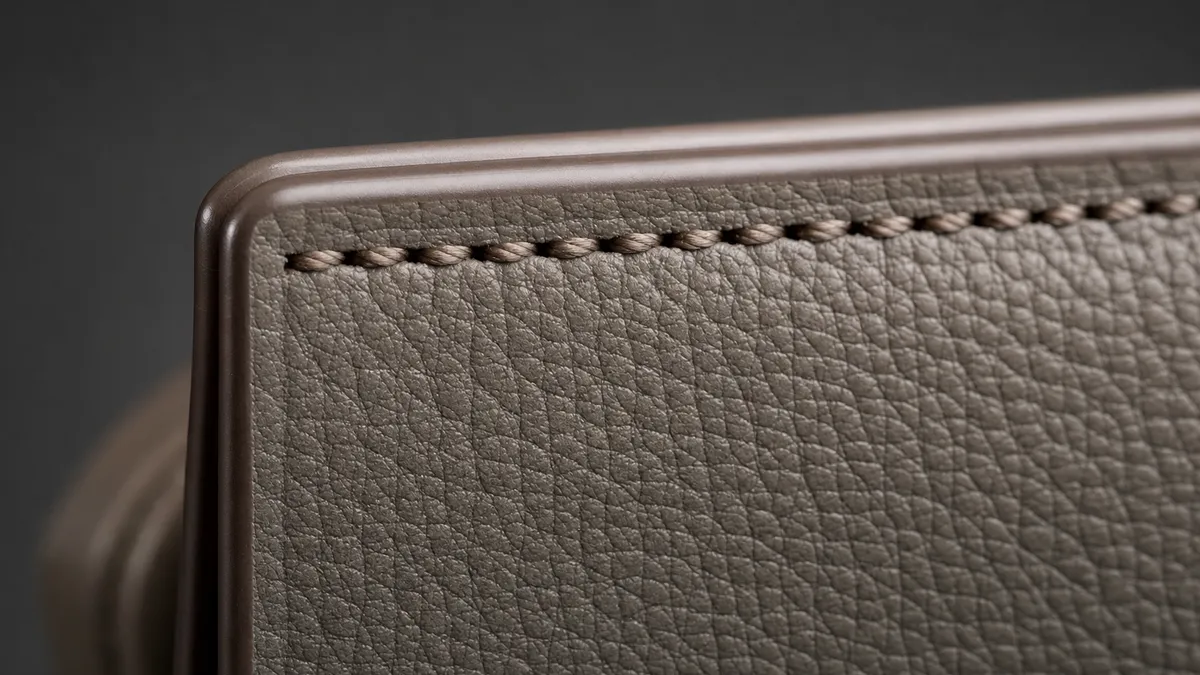 Authentic
 1. Goyardine pattern and chevron
Authentic: A crisp Y-shaped herringbone design at the correct scale with exact color registration; the diamond structure reads evenly and the lines don’t drift.
Fake: A blurry or crooked pattern, wrong chevron scale, off color registration – the design looks printed rather than stenciled onto a dense canvas.
2. Pattern alignment at seams
Authentic: The chevron continues logically across side seams and panel joints: the design doesn’t break off, and the lines meet consistently.
Fake: At the joints the pattern breaks off or runs out of step; replica factories cut without regard for the design and don’t align the chevron.
3. Hand-painted edges
Authentic: The leather edges and piping are hand-painted in a neat, unbroken line around the entire perimeter, with no drips or gaps.
Fake: An uneven paint line with drips, skips, or bleed onto the canvas; the edges are painted sloppily.
4. Embossing and address stamp
Authentic: The “GOYARD” embossing and the maison’s address stamp (a house since 1853) use a crisp, even typeface with exact geometry; the wording matches release references.
Fake: A faint, crooked, or mushy impression, the wrong typeface or spacing, spelling errors in the stamp.
5. Canvas, hardware, and lining
Authentic: The canvas looks matte and dense, with no glossy plasticky sheen, and the chevron weave texture is visible; the hardware has clean, even engraving with no bubbling, zipper teeth are even, and the lining is neatly sewn in.
Fake: A glossy, plasticky-looking material with a rubbery sheen, or a limp material; thin, stamped-looking hardware with a rough edge, mushy engraving, chipped zipper teeth, a sloppy lining.
6. Hand-painted personalization
Authentic: If painted initials are present (Goyard is known for hand-painted monograms), the lines are even and confident, the paint sits neatly, and the letter geometry is deliberate.
Fake: Shaky or uneven painted lines, bleeding paint, crooked letter geometry – an imitation of the hand personalization.
Popular Goyard models
Model-by-model checks – what to look at on each:
Where to inspect
The key zones to photograph and check on this type of item – a schematic, not a product photo.
- 1Logo and hardware
- 2Handle attachment
- 3Stitching and edges
- 4Date code and tag
- 5Zipper and base
How to photograph your Goyard for a check
Shoot in daylight, avoid glare, keep focus sharp. You need 5 angles:
- 1 Full bag (front)
- 2 Goyardine chevron close-up
- 3 Pattern alignment on a side seam
- 4 The “GOYARD” embossing and address stamp
- 5 Edges, edge paint, and hardware
How to read the result
The AI returns a verdict with a confidence score:
- 75–100% – Authentic: high confidence the item is genuine.
- 60–74% – Likely authentic: probably genuine with minor concerns.
- 40–59% – Uncertain: the photos are not conclusive – retake or add angles.
- 25–39% – Likely fake: several red flags.
- 0–24% – Fake: clear signs of a replica.
Check your Goyard right now
Snap photos of your item and get an AI verdict with a confidence score in about a minute.
FAQ
What’s the fastest way to authenticate a Goyard bag?
The “chevron + edges” pair. Check the crispness and correct scale of the Goyardine Y-pattern and its alignment across the seams, then the evenness of the hand-painted edges. Replicas almost always fail at least one of those two – both demand manufacturing that fake factories don’t have.
Is a Goyard authenticity check online by serial number possible?
Honestly, no: there is no public online database to “run” a Goyard number through, and the house itself does not perform online authentication. The app runs a fast photo screening – it reads the chevron, edges, embossing, and stamp – but that’s a screening on the full set of tells, not a serial lookup against a database. Any service promising to “verify Goyard by number” is misleading you.
Where are Goyard bags made?
Goyard is a French house, and production often is French, but don’t lean on a single country stamp: on its own it proves nothing and is trivial to fake. Weigh the country together with the rest of the tells – chevron, edges, embossing, and hardware.
Is a photo of the chevron enough for a legit check on a Goyard?
The Goyardine chevron is the strongest single signal, but a reliable verdict comes from the combination: pattern crispness and alignment + hand-painted edges + embossing and address stamp + canvas and hardware quality. The app tells you which angles to shoot and cross-references the bag against documented release references.