Guides · Streetwear
How to Tell if Your Gallery Dept Is Real or Fake (2026)
Gallery Dept is the hardest brand on the site to authenticate: the product itself is built on hand reworking clothing – paint, distressing, denim recutting – and intentional roughness is the design, not a flaw. That means the usual "compare it to a reference photo" approach doesn't apply here: no two genuine pieces of the same model ever match exactly. This guide covers what to look at instead of pattern-matching, the right angles to shoot, and how to check a piece from photos in about a minute.
Real vs fake Gallery Dept: comparison table
Data current as of July 2026. Replicas evolve, so judge by the combination of signs – never a single one.
| Sign | Authentic | Fake |
|---|---|---|
| Paint soaking into the fabric (hand-worked pieces: hoodies, sweats, La Flare) | Paint sinks into the weave or pile with a natural variation in layer density, and you can see brush marks or uneven application. Key exception: the ATK graphic on tees is screen-printed, where saturated, even print with no brush marks is the norm. | On hand-worked pieces, a flat uniform layer sitting on top like a sticker with no soaking in. On the screen-printed ATK graphic, coarse halftone, blurred small details, a doubled outline, or ink in clumps. |
| Edge of a mark or letter under magnification | On hand-worked pieces the transition is gradual, with individual fibers showing through the paint boundary. On the screen-printed ATK graphic the edge is clean and sharp instead, and that is the norm. | On a hand-worked piece, a sharp even boundary all the way around betrays a printed imitation. On the ATK graphic, the tell is not a sharp edge but print defects: a doubled outline, bare fabric inside a letter, ink past the outline. |
| Asymmetry and a one-of-a-kind pattern | Uneven line thickness, a slight slant, and a unique placement of splatter and distressing on each piece – exactly as expected from hand work. | A paint or distressing pattern that's identical across different "originals," or that matches one reference photo online exactly. |
| Denim rework and panels | The edge of cut and re-stitched fabric is neatly finished, the panel sits flush, and stitching on reworked areas holds even tension even when intentionally rough-looking. | A panel attached carelessly, a fraying fabric edge, and loose stitching with skips rather than a stylized rough finish. |
| Fabric weight | Dense, heavyweight cotton or fleece that holds its shape even after vintage-style treatment. | Thinner, lighter fabric that sees through in light or doesn't hold shape. |
| Interior tags and stitching | The label is stitched on evenly, with crisp printing or weaving of the name and size. | Crooked or sparse label stitching, blurry printing, and a font coarser than reference. |
The difference is in the details – drag the slider
Typical differences in workmanship: stitching consistency, edge finishing, detail quality. Left – factory quality, right – common replica flaws.
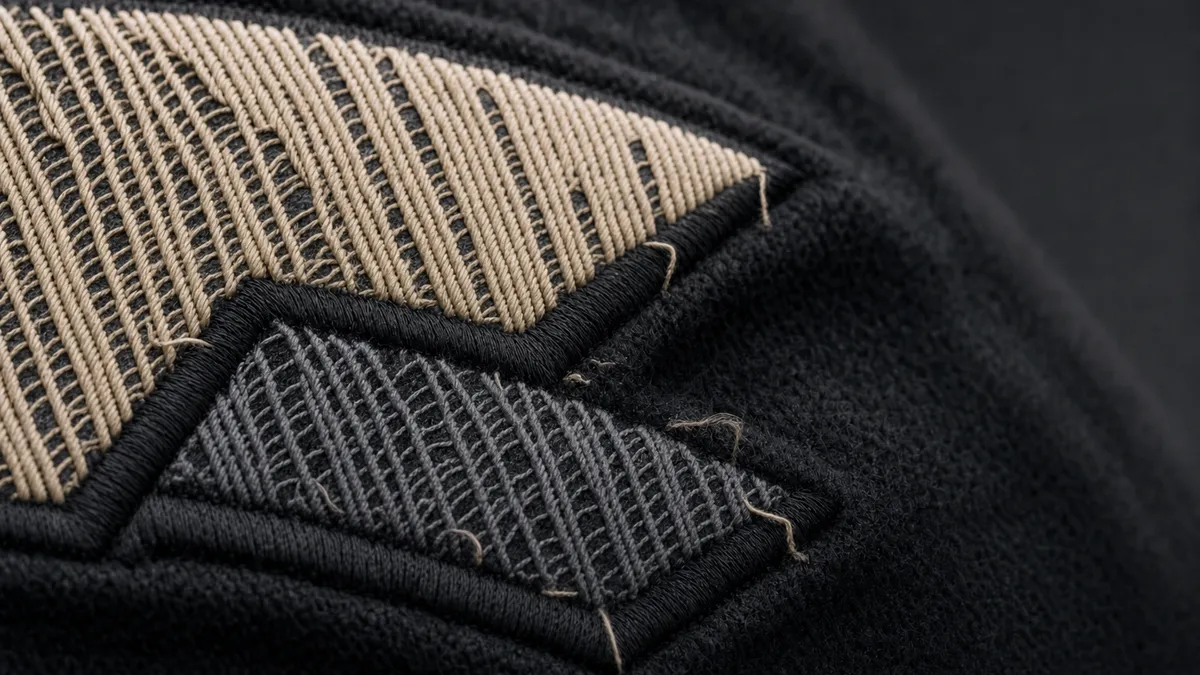 Replica
 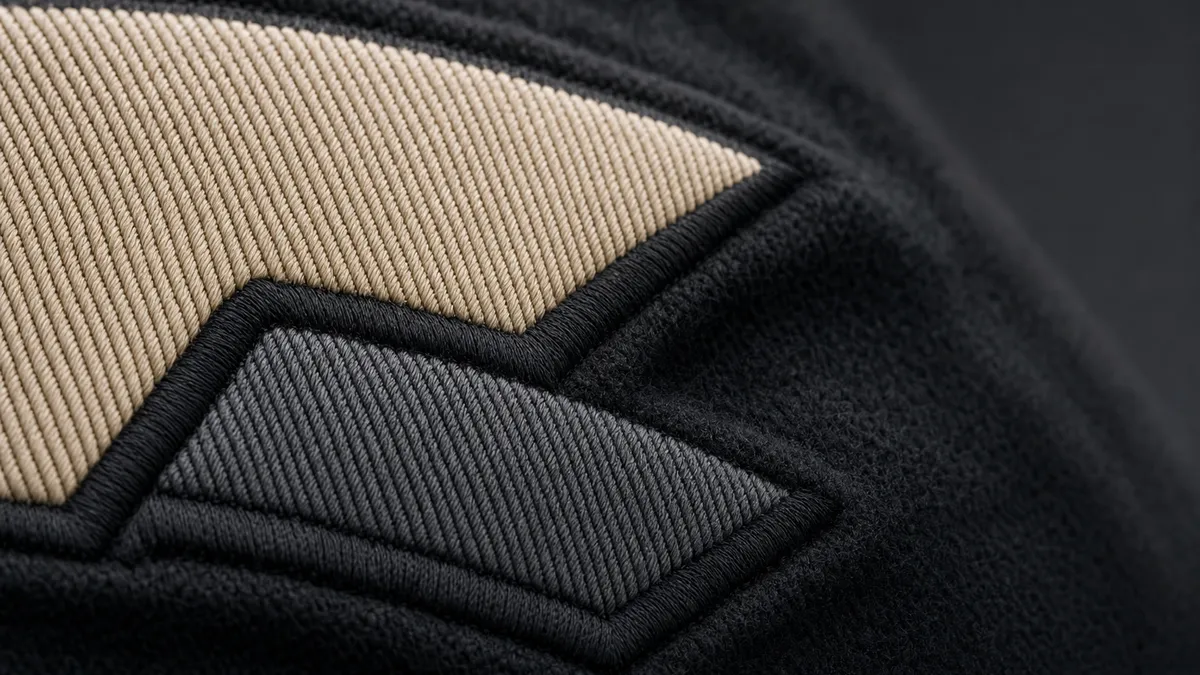 Authentic
 1. Paint soaking into the fabric (hand-worked pieces: hoodies, sweats, La Flare)
Authentic: Paint sinks into the weave or pile with a natural variation in layer density, and you can see brush marks or uneven application. Key exception: the ATK graphic on tees is screen-printed, where saturated, even print with no brush marks is the norm.
Fake: On hand-worked pieces, a flat uniform layer sitting on top like a sticker with no soaking in. On the screen-printed ATK graphic, coarse halftone, blurred small details, a doubled outline, or ink in clumps.
2. Edge of a mark or letter under magnification
Authentic: On hand-worked pieces the transition is gradual, with individual fibers showing through the paint boundary. On the screen-printed ATK graphic the edge is clean and sharp instead, and that is the norm.
Fake: On a hand-worked piece, a sharp even boundary all the way around betrays a printed imitation. On the ATK graphic, the tell is not a sharp edge but print defects: a doubled outline, bare fabric inside a letter, ink past the outline.
3. Asymmetry and a one-of-a-kind pattern
Authentic: Uneven line thickness, a slight slant, and a unique placement of splatter and distressing on each piece – exactly as expected from hand work.
Fake: A paint or distressing pattern that's identical across different "originals," or that matches one reference photo online exactly.
4. Denim rework and panels
Authentic: The edge of cut and re-stitched fabric is neatly finished, the panel sits flush, and stitching on reworked areas holds even tension even when intentionally rough-looking.
Fake: A panel attached carelessly, a fraying fabric edge, and loose stitching with skips rather than a stylized rough finish.
5. Fabric weight
Authentic: Dense, heavyweight cotton or fleece that holds its shape even after vintage-style treatment.
Fake: Thinner, lighter fabric that sees through in light or doesn't hold shape.
6. Interior tags and stitching
Authentic: The label is stitched on evenly, with crisp printing or weaving of the name and size.
Fake: Crooked or sparse label stitching, blurry printing, and a font coarser than reference.
Popular Gallery Dept models
Model-by-model checks – what to look at on each:
Where to inspect
The key zones to photograph and check on this type of item – a schematic, not a product photo.
- 1Neck label and tags
- 2Print and its printing
- 3Stitching and hem
- 4Shoulder and sleeve seam
- 5Fabric and weight
How to photograph your Gallery Dept for a check
Shoot in daylight, avoid glare, keep focus sharp. You need 5 angles:
- 1 Full item
- 2 A painted or distressed area close up (with a tight macro shot of the mark's edge)
- 3 Reworked seams and panels
- 4 Interior label and care tag
- 5 Fabric weight held up to light
How to read the result
The AI returns a verdict with a confidence score:
- 75–100% – Authentic: high confidence the item is genuine.
- 60–74% – Likely authentic: probably genuine with minor concerns.
- 40–59% – Uncertain: the photos are not conclusive – retake or add angles.
- 25–39% – Likely fake: several red flags.
- 0–24% – Fake: clear signs of a replica.
Check your Gallery Dept right now
Snap photos of your item and get an AI verdict with a confidence score in about a minute.
FAQ
Why doesn't the paint on my Gallery Dept piece look like photos I found online?
That's expected, not a red flag. Gallery Dept hand-paints and distresses its pieces, so the splatter, brushwork, and wear pattern is unique to each piece – no two are identical even within the same drop. The fake tell isn't a mismatch against someone else's photo, it's the application technique itself: does the paint soak into the fabric, is there brush texture, is the edge of the mark gradual.
Does that mean any uneven paintwork should be treated as genuine?
No. Unevenness is necessary but not sufficient. Look deeper: a printed replica can also look "messy" at a glance, but under magnification its edge turns out sharp and even all the way around, and the paint layer is a uniform thickness with no soak into the fiber. Genuine hand-applied paint gives a gradual, "fuzzy" edge and varying layer density.
Can I authenticate Gallery Dept from a tag or serial number?
Gallery Dept has no serial numbers or a database to check by code. Tags are easy to copy, so the verdict comes from the whole picture: the character of the hand-applied paint, the denim rework quality, the fabric weight, and the stitching neatness – combined with cross-checking the piece against documented references for that release.
How accurate is checking Gallery Dept from photos with AI?
Accuracy depends on photo quality, especially close-up shots of a paint or distressing edge. LegitCheck AI cross-references the application technique, the rework quality, the fabric, and the tags, and returns a verdict with a confidence score, honestly flagging "uncertain" when the photos don't provide enough detail. It's a fast screen, not a legally binding appraisal.