Guides · Luxury Accessories
How to Tell if Your Tiffany & Co. Is Real or Fake (2026)
Tiffany & Co. jewelry – the T bracelets, HardWear pendants, and Return to Tiffany tags – is one of the most copied luxury-accessory segments out there. The real thing rests on three things: crisp, deep hallmarks with a metal purity mark, the real heft of solid metal, and a flawless polish. It is the engraving, the density of the piece, and the finish where replicas give themselves away most often – not the packaging, which is the first thing counterfeiters copy.
Real vs fake Tiffany & Co.: comparison table
Data current as of July 2026. Replicas evolve, so judge by the combination of signs – never a single one.
| Sign | Authentic | Fake |
|---|---|---|
| Hallmarks and metal purity | The "Tiffany & Co." engraving and the purity mark ("925" for silver, "AU750" or "750" for 18k) are crisp, deep, and struck in an even house font with consistent kerning. | Tiny, smeared, or crooked characters, a wandering font, a wrong or missing purity mark, uneven engraving depth. |
| Weight and density | The original feels notably heavy for its size – solid metal; but weight itself is not something a photo can assess, that’s a hands-on test, and not being able to run it doesn’t lower the verdict. | From a photo, a hollow or cheap blank shows up as visible thin, see-through walls at seams or openings, or crude stamping instead of casting. Lightness and sound are a separate hands-on check. |
| Polish and transitions | An even mirror or satin surface with consistent shine, no waviness, stamping marks, or dull patches on the facets and bends. | Patchy, "soapy," or plasticky polish, waviness on the surface, scratches and dull zones on the transitions. |
| Return to Tiffany engraving | The "Please Return to Tiffany & Co. New York" wording runs in a clean, even font with consistent spacing and uniform depth along the whole arc of the tag. | Crooked or "dancing" letters, uneven kerning, inconsistent character depth, errors or abbreviations in the wording. |
| Hardware and joints | Clasps, bails, and jump rings are cleanly assembled, with the halves meeting flush and no visible gap, and are free of crude solder and burrs. | A visible gap or misalignment in the clasp, an open or skewed ring, a visible seam and excess solder at the joints. |
| Signature packaging | The box and pouch in the exact signature turquoise shade (a Pantone-like Tiffany Blue), dense card stock, tidy printing, and a clean finish. | A shade that is off (too green or too blue), thin card, smeared printing – but remember: even accurate packaging proves nothing. |
The difference is in the details – drag the slider
Typical differences in workmanship: stitching consistency, edge finishing, detail quality. Left – factory quality, right – common replica flaws.
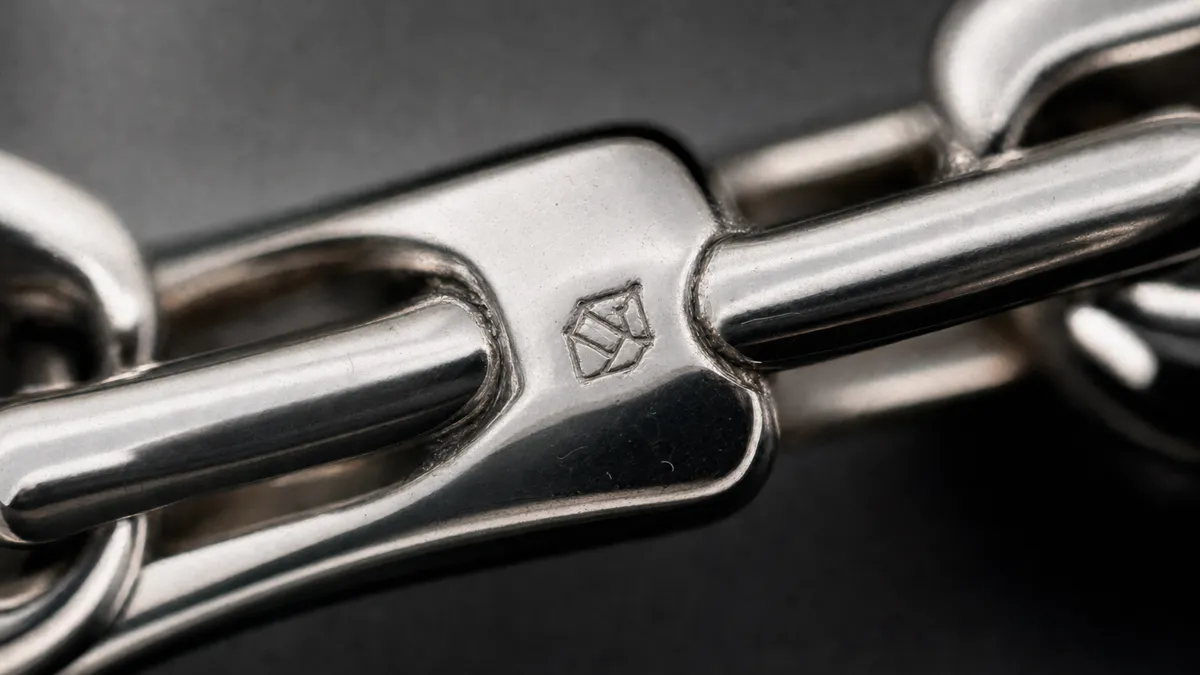 Replica
 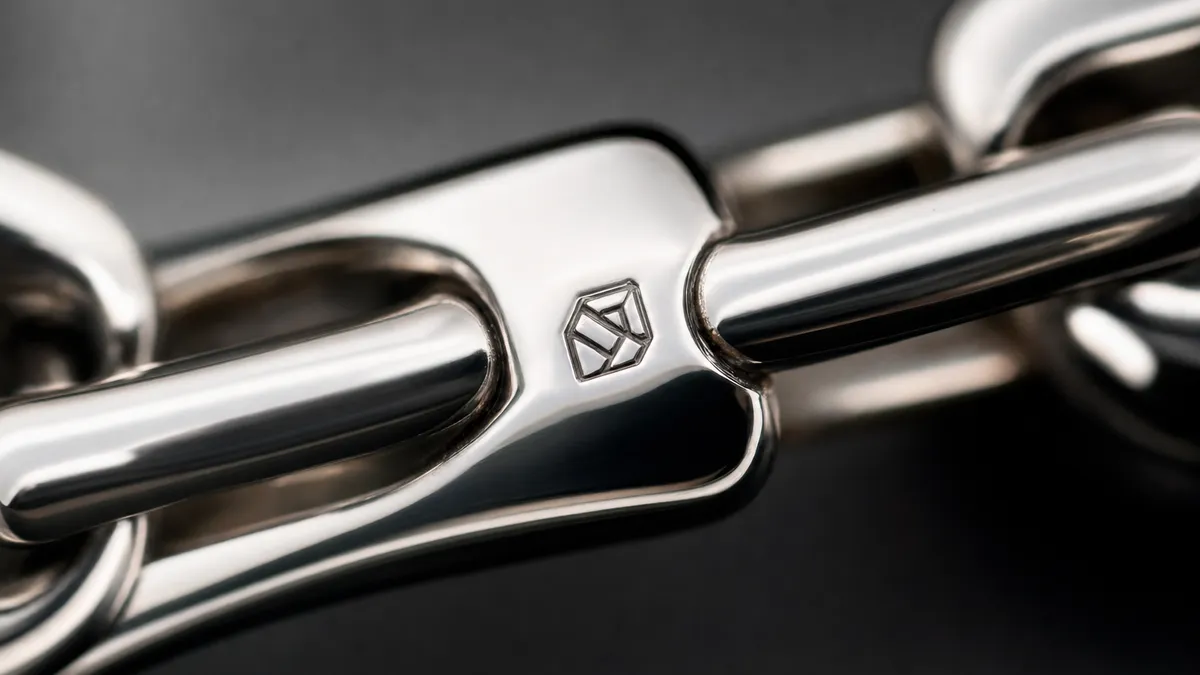 Authentic
 1. Hallmarks and metal purity
Authentic: The "Tiffany & Co." engraving and the purity mark ("925" for silver, "AU750" or "750" for 18k) are crisp, deep, and struck in an even house font with consistent kerning.
Fake: Tiny, smeared, or crooked characters, a wandering font, a wrong or missing purity mark, uneven engraving depth.
2. Weight and density
Authentic: The original feels notably heavy for its size – solid metal; but weight itself is not something a photo can assess, that’s a hands-on test, and not being able to run it doesn’t lower the verdict.
Fake: From a photo, a hollow or cheap blank shows up as visible thin, see-through walls at seams or openings, or crude stamping instead of casting. Lightness and sound are a separate hands-on check.
3. Polish and transitions
Authentic: An even mirror or satin surface with consistent shine, no waviness, stamping marks, or dull patches on the facets and bends.
Fake: Patchy, "soapy," or plasticky polish, waviness on the surface, scratches and dull zones on the transitions.
4. Return to Tiffany engraving
Authentic: The "Please Return to Tiffany & Co. New York" wording runs in a clean, even font with consistent spacing and uniform depth along the whole arc of the tag.
Fake: Crooked or "dancing" letters, uneven kerning, inconsistent character depth, errors or abbreviations in the wording.
5. Hardware and joints
Authentic: Clasps, bails, and jump rings are cleanly assembled, with the halves meeting flush and no visible gap, and are free of crude solder and burrs.
Fake: A visible gap or misalignment in the clasp, an open or skewed ring, a visible seam and excess solder at the joints.
6. Signature packaging
Authentic: The box and pouch in the exact signature turquoise shade (a Pantone-like Tiffany Blue), dense card stock, tidy printing, and a clean finish.
Fake: A shade that is off (too green or too blue), thin card, smeared printing – but remember: even accurate packaging proves nothing.
Popular Tiffany & Co. models
Model-by-model checks – what to look at on each:
Where to inspect
The key zones to photograph and check on this type of item – a schematic, not a product photo.
- 1Hallmark and purity
- 2Engraving
- 3Stone and setting
- 4Prongs and finish
- 5Band profile
How to photograph your Tiffany & Co. for a check
Shoot in daylight, avoid glare, keep focus sharp. You need 5 angles:
- 1 Full piece
- 2 Hallmark and purity mark close-up
- 3 Engraving (Return to Tiffany / house wording)
- 4 Clasp or joints
- 5 Signature packaging (box and pouch)
How to read the result
The AI returns a verdict with a confidence score:
- 75–100% – Authentic: high confidence the item is genuine.
- 60–74% – Likely authentic: probably genuine with minor concerns.
- 40–59% – Uncertain: the photos are not conclusive – retake or add angles.
- 25–39% – Likely fake: several red flags.
- 0–24% – Fake: clear signs of a replica.
Check your Tiffany & Co. right now
Snap photos of your item and get an AI verdict with a confidence score in about a minute.
FAQ
What's the fastest Tiffany tell?
The combination of "hallmarks + finish quality." On the real thing the "Tiffany & Co." engraving and the metal purity mark ("925" for silver, "AU750"/"750" for 18k) are crisp, deep, and in an even house font, and the polish is even with no waviness or burrs. A tiny, smeared, or crooked hallmark plus a rough, "cheap" finish is an immediate red flag. Weight is a strong extra tell, but it's a hands-on check, not something a photo shows.
Does the blue Tiffany box prove authenticity?
No. The signature turquoise box and pouch are the first things counterfeiters copy and prove nothing. Judge by the metal, the crispness of the hallmarks and purity mark, the weight, and the polish quality of the piece itself. Packaging is a nice extra, not evidence.
Can I verify a Tiffany piece by serial number?
No. Tiffany does not publicly stamp most jewelry with a decodable serial number, and there is no public database to check against. Rely on the hallmarks ("Tiffany & Co." and the metal purity mark), the weight, and the finish – not on "looking up" a serial that does not exist.
Is a photo of the hallmark enough?
The hallmark is the strongest single signal, but a reliable photo-based verdict comes from the combination: hallmarks + polish + hardware (clasps, rings, bails). Weight is a useful extra reference point, but it isn’t part of the photo verdict – that’s a hands-on test. The app tells you which angles to shoot and cross-references the piece against the model.