Guides · Luxury Shoes
How to Tell if Salvatore Ferragamo Shoes Are Real or Fake (2026)
Salvatore Ferragamo is defined by two signature details – the Vara bow with its metal plate, and the Gancini buckle styled after a horseshoe. Both are easy to photograph, and they're exactly where replicas trip up most: proportions, ribbon ribbing, and the shape and finish of the metal. One special trap is the 2022 rebrand, which means genuine marking looks different depending on the pair's age. Here's what to check.
Real vs fake Salvatore Ferragamo: comparison table
Data current as of July 2026. Replicas evolve, so judge by the combination of signs – never a single one.
| Sign | Authentic | Fake |
|---|---|---|
| Vara bow: proportions and placement | The bow sits centered on the instep, scaled correctly to the last, with a clean, symmetrical knot. | The bow is shifted off-center, lopsided, or disproportionately large for the last. |
| Bow ribbon | Grosgrain ribbon with dense, even cross-ribbing along its full length; cut ends are neatly finished. | Sparse, blurry ribbing, a cheap shine to the material, or a raw, frayed ribbon edge. |
| Vara plate engraving | Correct signature font, centered and level, with consistent line depth across the whole word. | Blurry or doubled-up lettering, uneven engraving depth, a coating that flakes at the edges. |
| Gancini buckle | A symmetrical stylized clasp with smooth even curves, uniform metal plating with no discoloration, mounted flush with no visible gap. | Asymmetrical or crude "shoulders" on the clasp, a finish that flakes in patches, a visible gap between the buckle and the saddle. |
| Marking: "Salvatore Ferragamo" vs. "Ferragamo" | After the 2022 rebrand, newer pieces carry the short "FERRAGAMO," older ones the full "Salvatore Ferragamo" – both are genuine. | Blurry, uneven stamping with doubled-up letters or a crooked line – regardless of which wording is used. |
| Leather, lasting and sole | Even leather dye, a cleanly finished cut edge, symmetrical lasting across the pair, a sole bonded with no glue overflow. | A raw, unfinished edge, noticeable asymmetry between the shoes, glue smears along the sole. |
The difference is in the details – drag the slider
Typical differences in workmanship: stitching consistency, edge finishing, detail quality. Left – factory quality, right – common replica flaws.
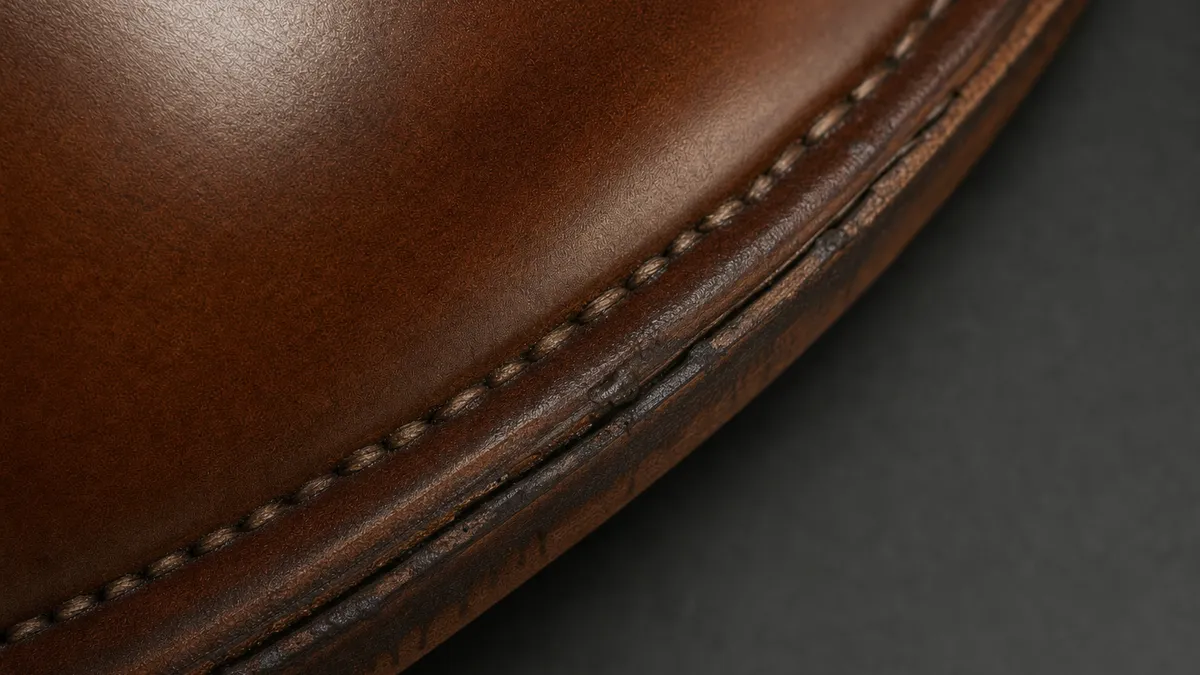 Replica
 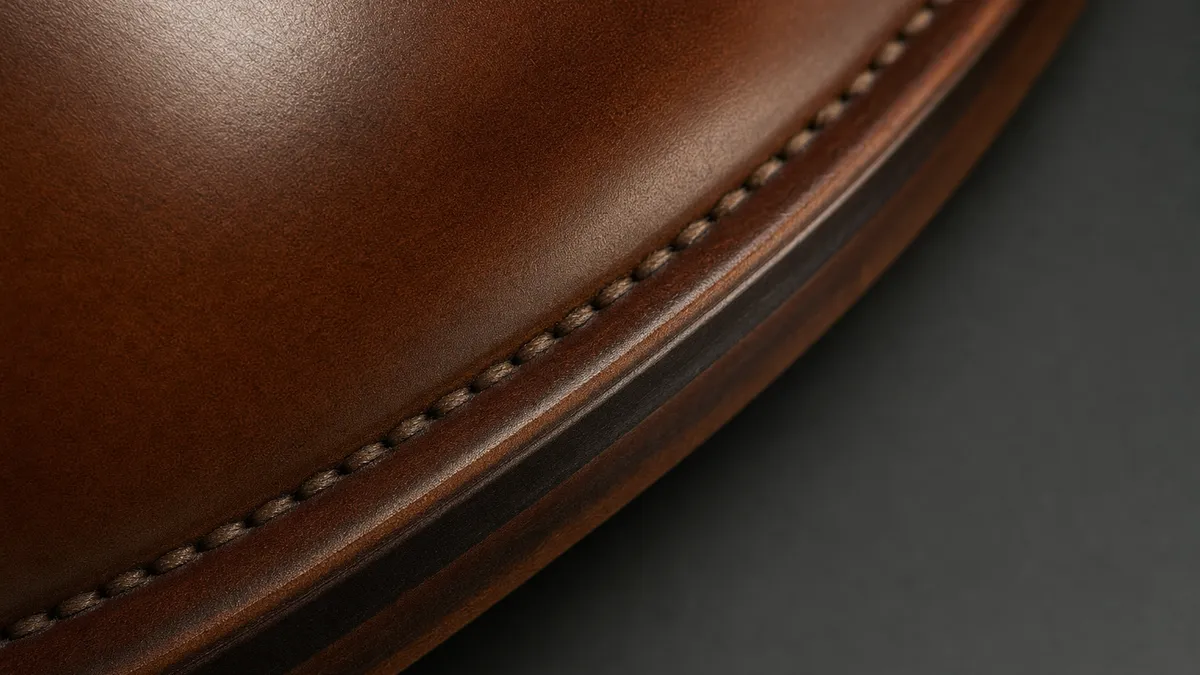 Authentic
 1. Vara bow: proportions and placement
Authentic: The bow sits centered on the instep, scaled correctly to the last, with a clean, symmetrical knot.
Fake: The bow is shifted off-center, lopsided, or disproportionately large for the last.
2. Bow ribbon
Authentic: Grosgrain ribbon with dense, even cross-ribbing along its full length; cut ends are neatly finished.
Fake: Sparse, blurry ribbing, a cheap shine to the material, or a raw, frayed ribbon edge.
3. Vara plate engraving
Authentic: Correct signature font, centered and level, with consistent line depth across the whole word.
Fake: Blurry or doubled-up lettering, uneven engraving depth, a coating that flakes at the edges.
4. Gancini buckle
Authentic: A symmetrical stylized clasp with smooth even curves, uniform metal plating with no discoloration, mounted flush with no visible gap.
Fake: Asymmetrical or crude "shoulders" on the clasp, a finish that flakes in patches, a visible gap between the buckle and the saddle.
5. Marking: "Salvatore Ferragamo" vs. "Ferragamo"
Authentic: After the 2022 rebrand, newer pieces carry the short "FERRAGAMO," older ones the full "Salvatore Ferragamo" – both are genuine.
Fake: Blurry, uneven stamping with doubled-up letters or a crooked line – regardless of which wording is used.
6. Leather, lasting and sole
Authentic: Even leather dye, a cleanly finished cut edge, symmetrical lasting across the pair, a sole bonded with no glue overflow.
Fake: A raw, unfinished edge, noticeable asymmetry between the shoes, glue smears along the sole.
Popular Salvatore Ferragamo models
Model-by-model checks – what to look at on each:
Where to inspect
The key zones to photograph and check on this type of item – a schematic, not a product photo.
- 1Insole branding
- 2Heel and tip
- 3Toe and profile
- 4Heel counter
- 5Stitching and sole
How to photograph your Salvatore Ferragamo for a check
Shoot in daylight, avoid glare, keep focus sharp. You need 5 angles:
- 1 The bow with its plate, close up
- 2 The Gancini buckle (on loafers)
- 3 The interior marking on the lining
- 4 The sole edge and bonding line
- 5 The full pair – left vs. right shoe
How to read the result
The AI returns a verdict with a confidence score:
- 75–100% – Authentic: high confidence the item is genuine.
- 60–74% – Likely authentic: probably genuine with minor concerns.
- 40–59% – Uncertain: the photos are not conclusive – retake or add angles.
- 25–39% – Likely fake: several red flags.
- 0–24% – Fake: clear signs of a replica.
Check your Salvatore Ferragamo right now
Snap photos of your item and get an AI verdict with a confidence score in about a minute.
FAQ
The shoe just says "FERRAGAMO" without "Salvatore" – is that fake?
No. Since 2022 the house has used a refreshed identity, and newer pieces are often stamped with the short "FERRAGAMO" wordmark. Older pairs carry the full "Salvatore Ferragamo" – both are genuine, and the difference simply reflects the production year, not authenticity. This is the most common source of a false verdict for this brand.
Can I verify Ferragamo shoes by their serial number online?
There is no public database for checking Ferragamo serial numbers. A fake can carry a code that looks valid, while a genuine pair can have one that's worn off or illegible. Focus on execution quality – the bow, the buckle, the leather, and the build – rather than a number lookup.
The shoes weren't made in Italy – does that mean they're fake?
Not necessarily. The house's footwear is typically Italian-made, but the country stamp itself is easy for a replica to copy, so it can't be the sole criterion. Weigh it together with the signature hardware (bow or buckle), leather quality, engraving, and build.
The sole was reglued and the heel taps replaced – is that a bad sign?
No, resoling and heel-tap replacement are normal shoe maintenance and don't make a pair fake. Judge authenticity by the signature details (the bow and plate, or the Gancini buckle), the leather, and the build quality – not by signs of repair or wear.