Guides · Luxury Shoes
How to Tell if Manolo Blahnik Shoes Are Real or Fake (2026)
Manolo Blahnik is known for its elegant last and attention to detail – and that detail is exactly what’s hardest to replicate. Fakes typically fall short on precision: the leather is finished more roughly, the stitching is uneven, and the left and right shoe don’t quite match each other. Here’s what to check first – without relying on codes or item numbers, which can’t be verified from a photo.
Real vs fake Manolo Blahnik: comparison table
Data current as of July 2026. Replicas evolve, so judge by the combination of signs – never a single one.
| Sign | Authentic | Fake |
|---|---|---|
| Leather and edge finishing | Good-quality leather or suede with no obvious flaws; exposed cut edges on the pieces are neatly finished (dyed or burnished), with no fraying or raw edges. | Cheap leather with an artificial sheen or a synthetic smell; raw, frayed, or crumbling cut edges on the pieces. |
| Stitching | Even, consistent stitch spacing along the full seam, steady thread tension, no loops or breaks. | Uneven spacing, inconsistent tension, skipped stitches, or loose and clipped threads sticking out. |
| Pair symmetry | The left and right shoe mirror each other exactly: matching last shape, heel height and pitch, and matching placement of decoration and seams. | A noticeable mismatch between the two shoes – different heel height, shifted decoration, or a mismatched toe shape. |
| Heel shape and finish | The heel is geometrically even with no lean; the surface (lacquer, leather, or wood) is polished cleanly and uniformly. | A crooked or leaning heel, a rough or patchy polish, and visible tooling marks or chips on a new pair. |
| Hardware and buckles | Decorative hardware (buckles, crystals, bows) matches on both shoes, sits securely with no wobble or misalignment, and any metal engraving is crisp. | Hardware that differs in size or shape between the left and right shoe, sits crookedly, or has blurry or missing engraving. |
| Insole and sole | The insole stamping is even, with crisp letters of consistent depth; the sole is glued cleanly, with a tidy edge and no adhesive squeeze-out. | Smudged or uneven stamping, letters of inconsistent depth; a sloppily glued sole with adhesive spilling over the edge or an uneven seam. |
The difference is in the details – drag the slider
Typical differences in workmanship: stitching consistency, edge finishing, detail quality. Left – factory quality, right – common replica flaws.
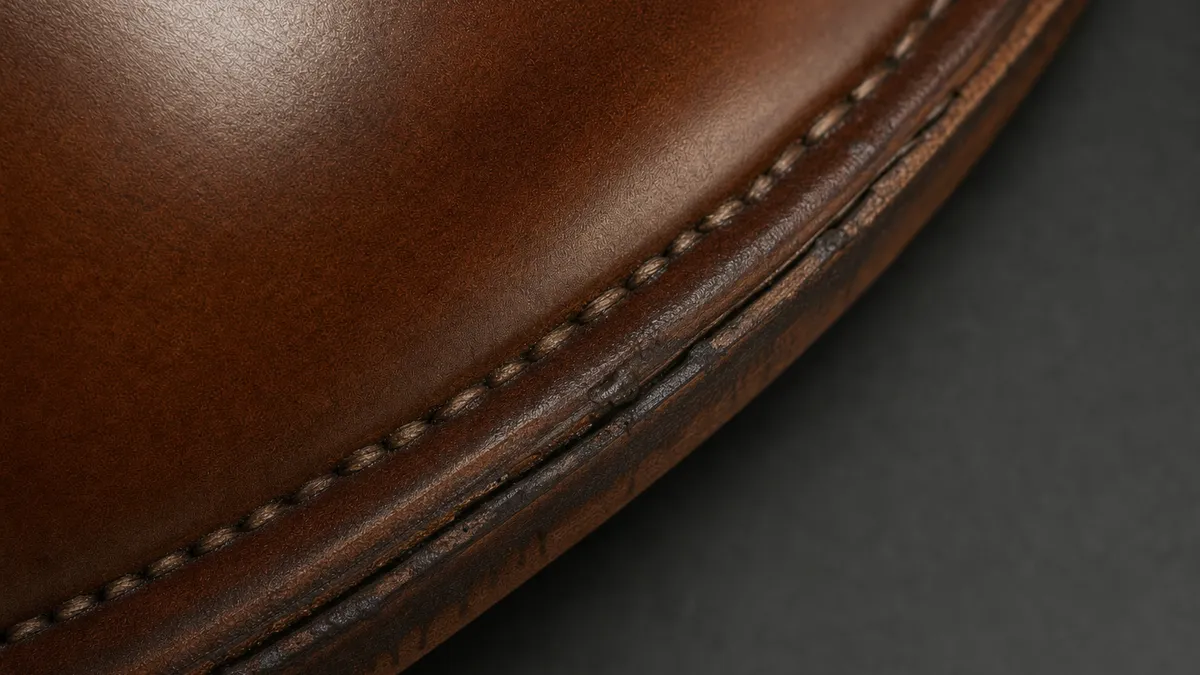 Replica
 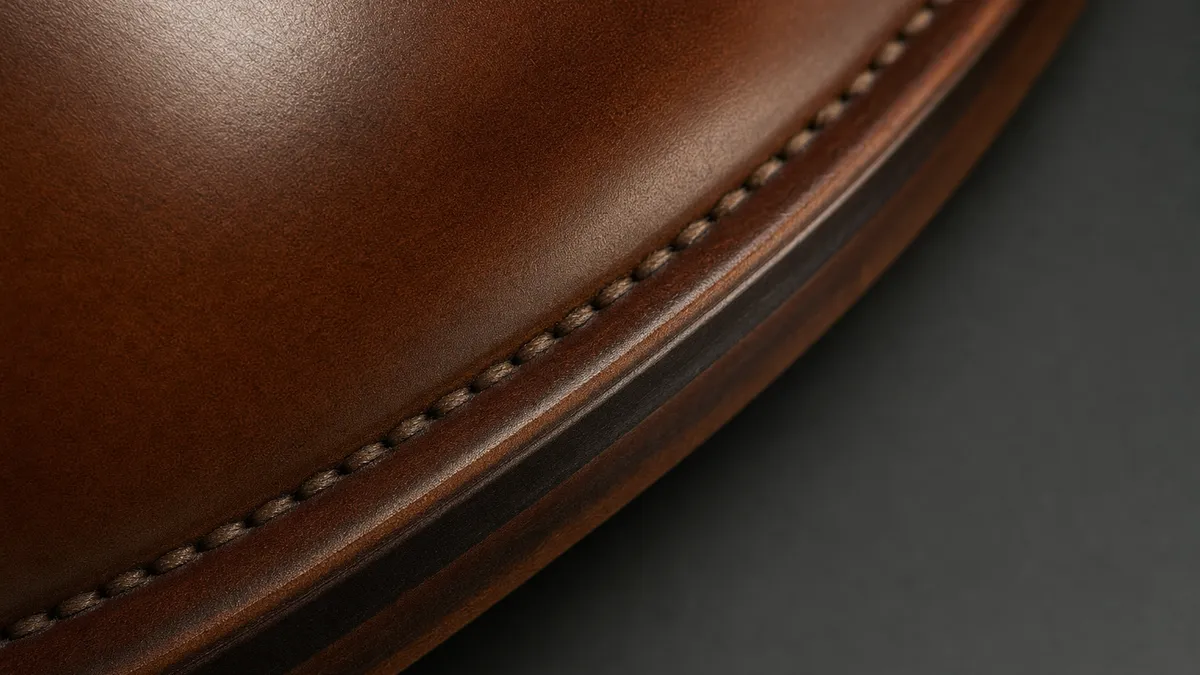 Authentic
 1. Leather and edge finishing
Authentic: Good-quality leather or suede with no obvious flaws; exposed cut edges on the pieces are neatly finished (dyed or burnished), with no fraying or raw edges.
Fake: Cheap leather with an artificial sheen or a synthetic smell; raw, frayed, or crumbling cut edges on the pieces.
2. Stitching
Authentic: Even, consistent stitch spacing along the full seam, steady thread tension, no loops or breaks.
Fake: Uneven spacing, inconsistent tension, skipped stitches, or loose and clipped threads sticking out.
3. Pair symmetry
Authentic: The left and right shoe mirror each other exactly: matching last shape, heel height and pitch, and matching placement of decoration and seams.
Fake: A noticeable mismatch between the two shoes – different heel height, shifted decoration, or a mismatched toe shape.
4. Heel shape and finish
Authentic: The heel is geometrically even with no lean; the surface (lacquer, leather, or wood) is polished cleanly and uniformly.
Fake: A crooked or leaning heel, a rough or patchy polish, and visible tooling marks or chips on a new pair.
5. Hardware and buckles
Authentic: Decorative hardware (buckles, crystals, bows) matches on both shoes, sits securely with no wobble or misalignment, and any metal engraving is crisp.
Fake: Hardware that differs in size or shape between the left and right shoe, sits crookedly, or has blurry or missing engraving.
6. Insole and sole
Authentic: The insole stamping is even, with crisp letters of consistent depth; the sole is glued cleanly, with a tidy edge and no adhesive squeeze-out.
Fake: Smudged or uneven stamping, letters of inconsistent depth; a sloppily glued sole with adhesive spilling over the edge or an uneven seam.
Where to inspect
The key zones to photograph and check on this type of item – a schematic, not a product photo.
- 1Insole branding
- 2Heel and tip
- 3Toe and profile
- 4Heel counter
- 5Stitching and sole
How to photograph your Manolo Blahnik for a check
Shoot in daylight, avoid glare, keep focus sharp. You need 5 angles:
- 1 Both shoes together, side by side (pair comparison)
- 2 Insole with the stamping
- 3 Hardware or buckle close-up
- 4 Heel from the side
- 5 Sole and where it meets the upper
How to read the result
The AI returns a verdict with a confidence score:
- 75–100% – Authentic: high confidence the item is genuine.
- 60–74% – Likely authentic: probably genuine with minor concerns.
- 40–59% – Uncertain: the photos are not conclusive – retake or add angles.
- 25–39% – Likely fake: several red flags.
- 0–24% – Fake: clear signs of a replica.
Check your Manolo Blahnik right now
Snap photos of your item and get an AI verdict with a confidence score in about a minute.
FAQ
The sole is worn and the heel tip has been replaced – is that a fake?
No. Wear marks, a worn sole, or a replaced heel tip or sole are repairs and normal use, not signs of a fake. Judge the leather quality, stitching, pair symmetry, hardware, and insole stamping instead of the condition of a worn shoe.
Can I verify the shoes by an item number?
There is no public database for checking Manolo Blahnik by an item number or insole code. Such markings are among the first things a replica copies, so the verdict should rest on the leather, stitching, pair symmetry, and overall build quality instead.
The shoes weren’t made in Italy – does that mean they’re fake?
Not necessarily. The brand’s shoes are, as a rule, made in Italy, but judging authenticity by the country line on a label alone is unreliable – labels and text are the easiest thing to copy first. Look at the overall build quality: leather finishing, stitching, and stamping.
The seller shows the box and dust bag – is that enough?
No. The box and dust bag get faked along with the shoes and aren’t tied to a specific pair. Judge the shoes themselves: the leather and cut edges, the stitching, left-right symmetry, the hardware, the heel, and the insole.