Guides · Luxury Shoes
How to Tell if Your Jimmy Choo Is Real or Fake (2026)
Jimmy Choo shoes – the pointed Romy 100 and Anouk 120 pumps, the minimalist Love 100, the crystal Bing 100, the Diamond Sneaker, and the strappy Lang sandals – are among the most copied categories in luxury footwear. The real thing rests on three things: the exact “JIMMY CHOO” stamp on the insole and sole, clean handwork with a neat heel wrap and even seams, and the quality of the leather, lining, and signature packaging. It’s the font, the heel set, and the material quality where replicas give themselves away most often.
Real vs fake Jimmy Choo: comparison table
Data current as of July 2026. Replicas evolve, so judge by the combination of signs – never a single one.
| Sign | Authentic | Fake |
|---|---|---|
| Insole stamp | Inside, “JIMMY CHOO” with a small “London” beneath it in the house font: even kerning, correct letter weight, a clean gilt or embossed print, centered. “MADE IN ITALY” and the size sit on the sole rather than the insole, so their absence inside is normal. | A typeface that nearly matches the house font but has the wrong letter weight or proportions, cramped or crooked letters, off-center text, a faded or over-pressed stamp. |
| Heel: set and pitch | A slim stiletto with the correct pitch and a firm, gap-free attachment to the sole; the height matches the model (100 or 120 mm). This check is for heeled models – the Romy 100, Anouk 120, Love 100, Bing 100 and the Lang sandals; the Diamond Sneaker has a flat faceted sole, so there is no stiletto to judge. | A thick, short or crookedly seated heel, a visible gap at the attachment, a height lowered from the model. |
| Heel wrap and seams | A neat heel wrap with no wrinkles or glue traces; even, dense stitching and clean handwork. | Wrinkled or skewed wrap, glue traces, loose stitches and stray threads. |
| Leather, lining and material | Quality leather/suede/patent upper and a tidy lining; glitter sits in a dense, even layer, crystals are clean and of a uniform size. | Cheap stock, cloudy patent, patchy glitter, mismatched stones, a crude or untidy lining. |
| Sole and edge | A leather sole with crisp branding, “MADE IN ITALY” and the size (some pairs also carry “VERO CUOIO”), an evenly painted rim along the whole edge, a neat welt. | A blurry stamp, uneven or peeling edge paint, a crude welt, a crooked bond. |
| Dust bag, box and country | A signature dust bag and box with the correct logo and font; the country of manufacture matches the specific model – most lines are Made in Italy, but wedges, espadrilles and several other genuine models are officially Made in Spain. | A cheap dust bag, a box with the wrong logo or font, packaging that doesn’t match the release. A different country of manufacture is not a fake tell on its own – check it against the specific model’s spec. |
The difference is in the details – drag the slider
Typical differences in workmanship: stitching consistency, edge finishing, detail quality. Left – factory quality, right – common replica flaws.
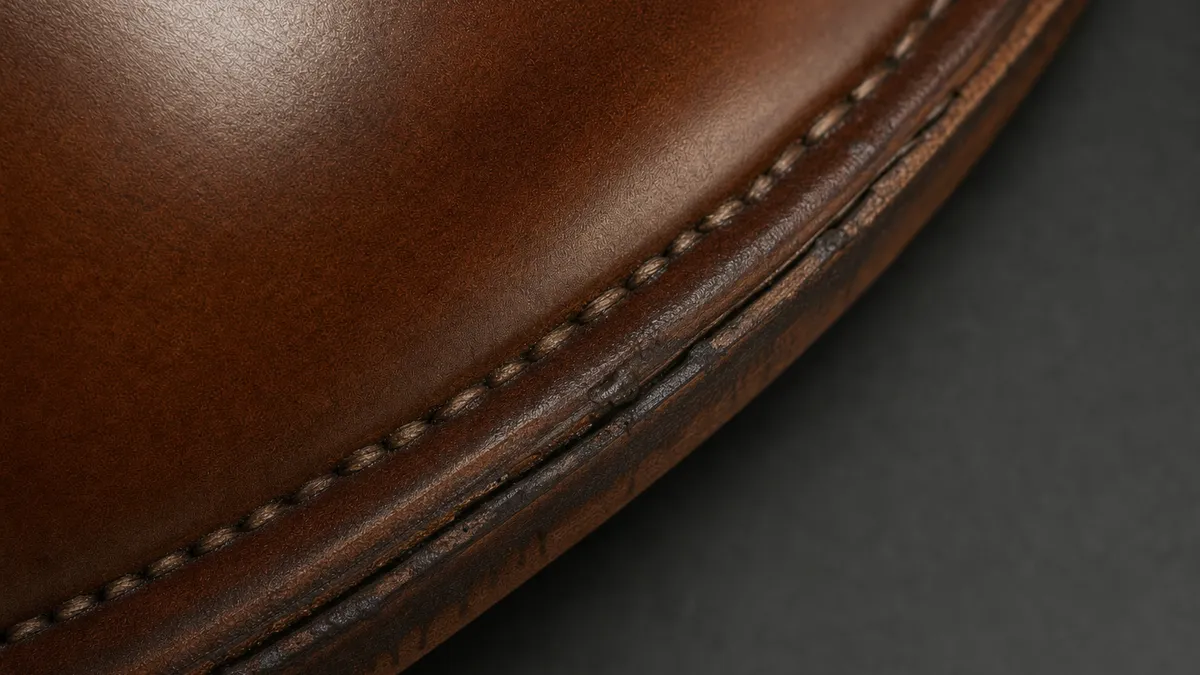 Replica
 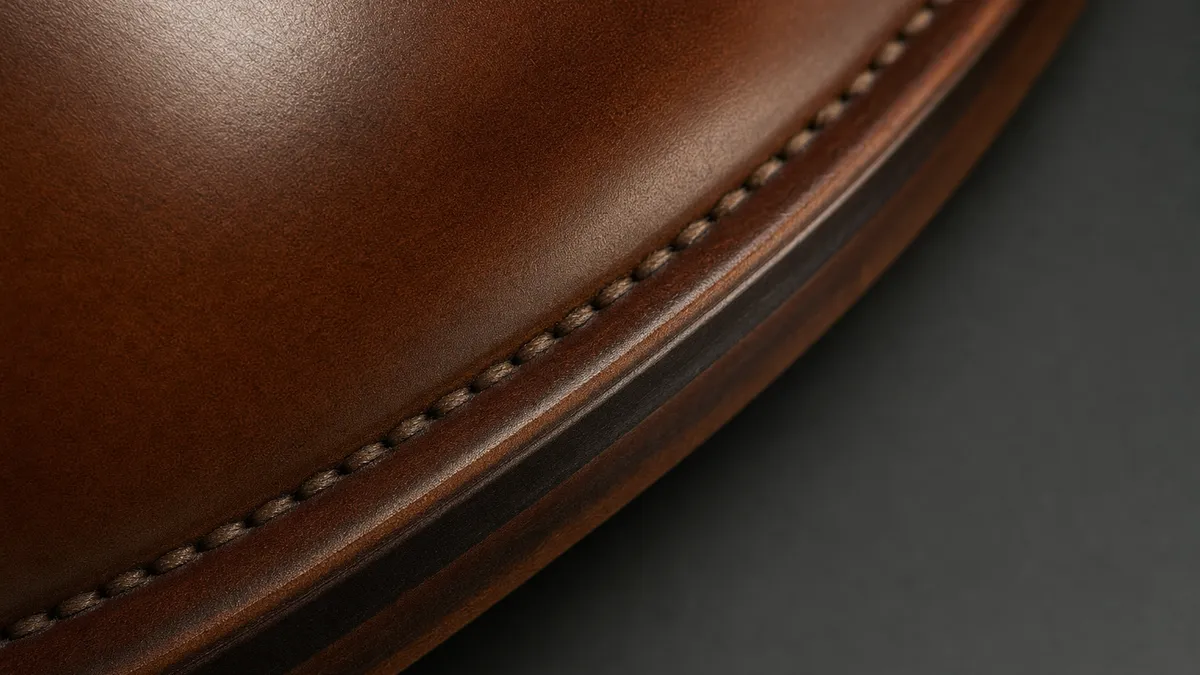 Authentic
 1. Insole stamp
Authentic: Inside, “JIMMY CHOO” with a small “London” beneath it in the house font: even kerning, correct letter weight, a clean gilt or embossed print, centered. “MADE IN ITALY” and the size sit on the sole rather than the insole, so their absence inside is normal.
Fake: A typeface that nearly matches the house font but has the wrong letter weight or proportions, cramped or crooked letters, off-center text, a faded or over-pressed stamp.
2. Heel: set and pitch
Authentic: A slim stiletto with the correct pitch and a firm, gap-free attachment to the sole; the height matches the model (100 or 120 mm). This check is for heeled models – the Romy 100, Anouk 120, Love 100, Bing 100 and the Lang sandals; the Diamond Sneaker has a flat faceted sole, so there is no stiletto to judge.
Fake: A thick, short or crookedly seated heel, a visible gap at the attachment, a height lowered from the model.
3. Heel wrap and seams
Authentic: A neat heel wrap with no wrinkles or glue traces; even, dense stitching and clean handwork.
Fake: Wrinkled or skewed wrap, glue traces, loose stitches and stray threads.
4. Leather, lining and material
Authentic: Quality leather/suede/patent upper and a tidy lining; glitter sits in a dense, even layer, crystals are clean and of a uniform size.
Fake: Cheap stock, cloudy patent, patchy glitter, mismatched stones, a crude or untidy lining.
5. Sole and edge
Authentic: A leather sole with crisp branding, “MADE IN ITALY” and the size (some pairs also carry “VERO CUOIO”), an evenly painted rim along the whole edge, a neat welt.
Fake: A blurry stamp, uneven or peeling edge paint, a crude welt, a crooked bond.
6. Dust bag, box and country
Authentic: A signature dust bag and box with the correct logo and font; the country of manufacture matches the specific model – most lines are Made in Italy, but wedges, espadrilles and several other genuine models are officially Made in Spain.
Fake: A cheap dust bag, a box with the wrong logo or font, packaging that doesn’t match the release. A different country of manufacture is not a fake tell on its own – check it against the specific model’s spec.
Popular Jimmy Choo models
Model-by-model checks – what to look at on each:
Where to inspect
The key zones to photograph and check on this type of item – a schematic, not a product photo.
- 1Insole branding
- 2Heel and tip
- 3Toe and profile
- 4Heel counter
- 5Stitching and sole
How to photograph your Jimmy Choo for a check
Shoot in daylight, avoid glare, keep focus sharp. You need 5 angles:
- 1 Full shoe (silhouette and toe)
- 2 Insole stamp close-up
- 3 Heel and attachment point
- 4 Sole and edge paint
- 5 Leather/material, glitter or crystals
How to read the result
The AI returns a verdict with a confidence score:
- 75–100% – Authentic: high confidence the item is genuine.
- 60–74% – Likely authentic: probably genuine with minor concerns.
- 40–59% – Uncertain: the photos are not conclusive – retake or add angles.
- 25–39% – Likely fake: several red flags.
- 0–24% – Fake: clear signs of a replica.
Check your Jimmy Choo right now
Snap photos of your item and get an AI verdict with a confidence score in about a minute.
FAQ
What’s the fastest Jimmy Choo tell?
The combination of “insole stamp + heel set.” On the real thing the insole reads “JIMMY CHOO” with a small “London” beneath it in the house font, with even kerning and a clean, centered print, and the slim stiletto sits straight with the correct pitch and no visible gap at the sole. Type that nearly matches the house font but has the wrong letter weight, or a thick, crooked heel, is an immediate red flag. The stiletto is checked on heeled models; the flat Diamond Sneaker has none.
Is the number in the name (100, 120) a serial number?
No. The numeric suffix on a Jimmy Choo is the heel height in millimeters: the Romy 100 and Love 100 sit on a 100 mm stiletto, the Anouk 120 on a 120 mm one. It’s not a style code or a database-checkable serial – it’s a heel-height label that makes it easy to cross-check a model’s geometry. The stiletto is checked on heeled models; the flat Diamond Sneaker has none.
How do I check the packaging and country of manufacture?
A genuine pair arrives with a signature dust bag and box – correct logo, font, and layout. Look for the country on the sole rather than the insole: most models carry “MADE IN ITALY” next to the size. That said, some genuine Jimmy Choo lines – wedges, espadrilles and others – are officially produced in Spain and marked “Made in Spain,” so the country alone proves nothing and has to be matched to the specific model. A cheap dust bag or a box with the wrong logo or font is the real warning sign.
Is a photo of the insole enough?
The insole stamp is the strongest single signal, but a reliable verdict comes from the combination: insole font + heel set and wrap + seams and build + leather quality + the sole with its size and country. The app tells you which angles to shoot and cross-references the pair against the specific model and release.