Guides · Streetwear
How to Tell if Your Essentials Is Real or Fake (2026)
Essentials is Jerry Lorenzo’s Fear of God diffusion line, and it’s copied more than almost anything else in streetwear because of its recognizable rubber logo patch. The good news: replicas almost always fall apart on the patch itself — the font, thickness, letter spacing, and position. This guide covers how to check the rubber tag, the “1977” detail, the interior tags, and the fabric weight, the right angles to shoot, and how to verify a piece from photos in about a minute. One caveat: Essentials has no public lookup database and details change season to season, so always cross-reference a piece against documented references for its specific drop.
Real vs fake Essentials: comparison table
Data current as of July 2026. Replicas evolve, so judge by the combination of signs — never a single one.
| Sign | Authentic | Fake |
|---|---|---|
| Rubber tag (logo patch) | A raised rubber/silicone “ESSENTIALS” and “FEAR OF GOD” application in an even layer, with the correct font, thickness, and letter spacing and clean edges with no bubbling. | The wrong typeface, crooked spacing, the wrong size or thickness, messy patch edges, and lifting or cracking. |
| Large “ESSENTIALS” print | A flock/rubber print on the back or chest in the correct font and point size, set level across. | A shifted or crooked print, the wrong letter weight and width, and a thin or cracked application. |
| “1977” detail | On some drops, a crisp rubber/flock “1977” print in the correct font and position, correct for the specific release. | The wrong digit font, a blurry or shifted print, or a “1977” added where the drop never carried one. |
| Fabric and fit | Heavyweight, dense fleece or jersey that holds shape; a pronounced oversized, drop-shoulder cut; rubber drawcord tips and even stitching. | Thin, loose-knit fabric, the wrong fit (too slim or short), slack ribbing, crooked stitching, and cheap tips. |
| Interior tags | A neck label and care tag with “FEAR OF GOD” / “ESSENTIALS,” clean printing, correct fonts, and straight stitching. | Blurry lettering, a coarse font, a crookedly sewn tag, and a code/SKU format that doesn’t match documented references for the drop. |
| Color and seasonal cross-check | The shade matches the specific drop exactly; details, cut, and branding line up with documented references for the season. | A shade that misses the release, details and branding that don’t match the real drop, and signs of mixed seasons. |
The difference is in the details — drag the slider
Typical differences in workmanship: stitching consistency, edge finishing, detail quality. Left — factory quality, right — common replica flaws.
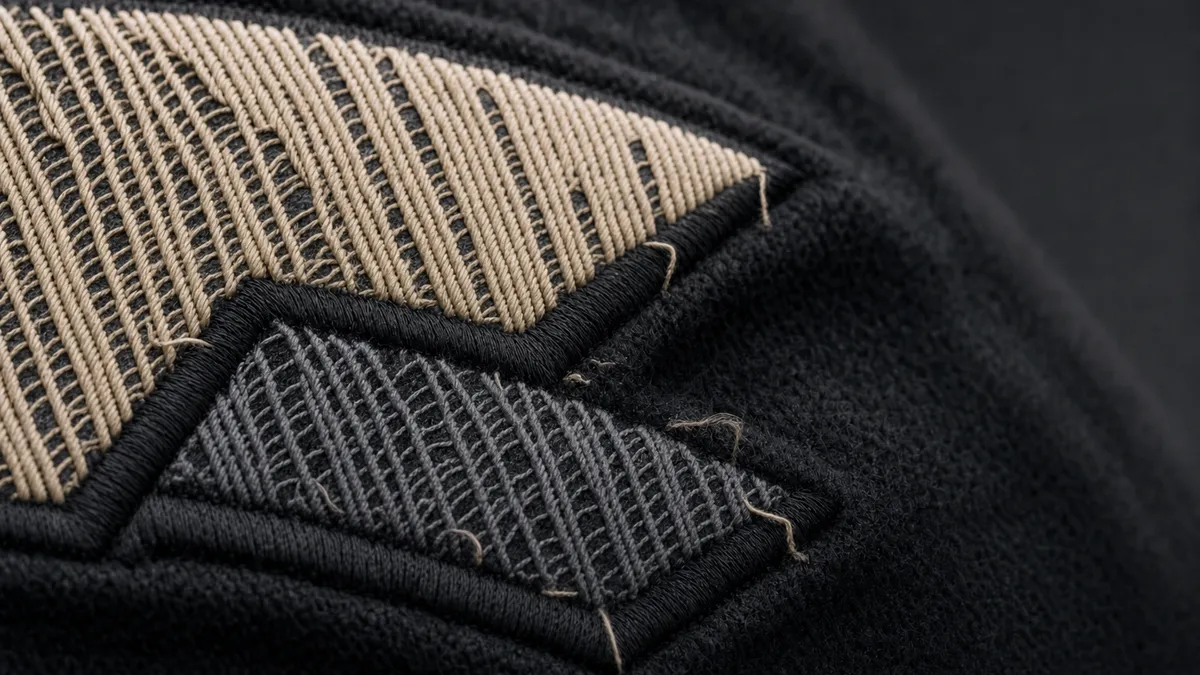 Replica
 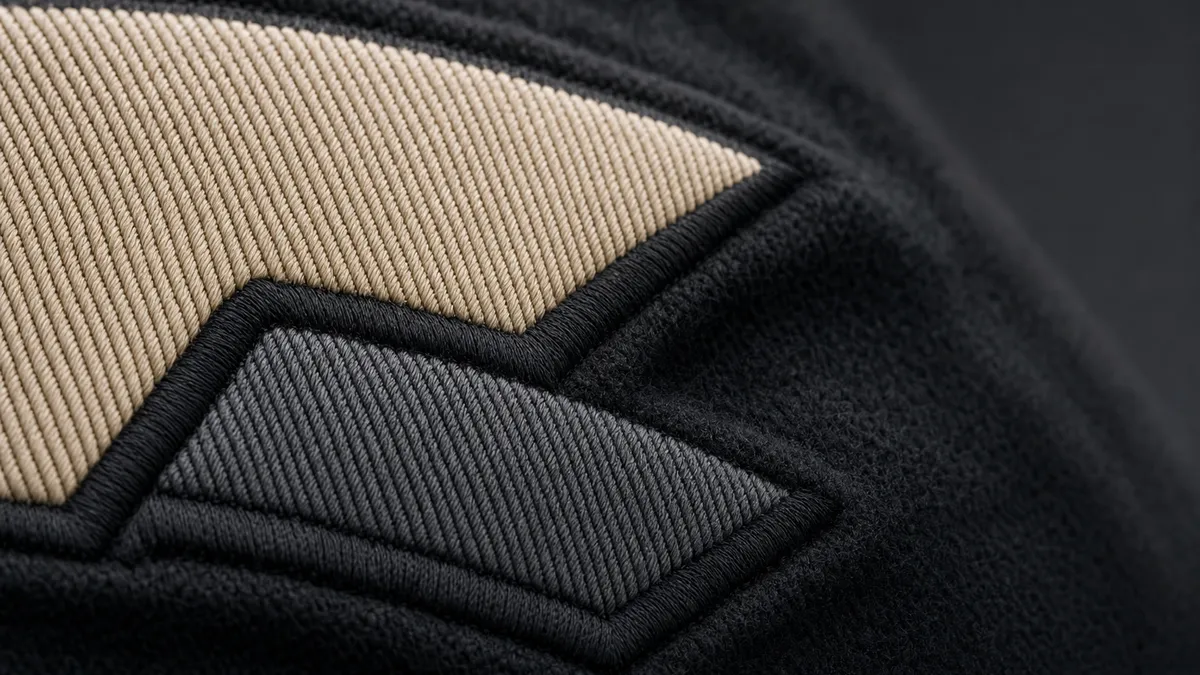 Authentic
 1. Rubber tag (logo patch)
Authentic: A raised rubber/silicone “ESSENTIALS” and “FEAR OF GOD” application in an even layer, with the correct font, thickness, and letter spacing and clean edges with no bubbling.
Fake: The wrong typeface, crooked spacing, the wrong size or thickness, messy patch edges, and lifting or cracking.
2. Large “ESSENTIALS” print
Authentic: A flock/rubber print on the back or chest in the correct font and point size, set level across.
Fake: A shifted or crooked print, the wrong letter weight and width, and a thin or cracked application.
3. “1977” detail
Authentic: On some drops, a crisp rubber/flock “1977” print in the correct font and position, correct for the specific release.
Fake: The wrong digit font, a blurry or shifted print, or a “1977” added where the drop never carried one.
4. Fabric and fit
Authentic: Heavyweight, dense fleece or jersey that holds shape; a pronounced oversized, drop-shoulder cut; rubber drawcord tips and even stitching.
Fake: Thin, loose-knit fabric, the wrong fit (too slim or short), slack ribbing, crooked stitching, and cheap tips.
5. Interior tags
Authentic: A neck label and care tag with “FEAR OF GOD” / “ESSENTIALS,” clean printing, correct fonts, and straight stitching.
Fake: Blurry lettering, a coarse font, a crookedly sewn tag, and a code/SKU format that doesn’t match documented references for the drop.
6. Color and seasonal cross-check
Authentic: The shade matches the specific drop exactly; details, cut, and branding line up with documented references for the season.
Fake: A shade that misses the release, details and branding that don’t match the real drop, and signs of mixed seasons.
Popular Essentials models
Model-by-model checks — what to look at on each:
Where to inspect
The key zones to photograph and check on this type of item — a schematic, not a product photo.
- 1Neck label and tags
- 2Print and its printing
- 3Stitching and hem
- 4Shoulder and sleeve seam
- 5Fabric and weight
How to photograph your Essentials for a check
Shoot in daylight, avoid glare, keep focus sharp. You need 5 angles:
- 1 Full item (front)
- 2 Rubber logo patch close-up
- 3 Large “ESSENTIALS” print and “1977” detail
- 4 Interior tags (neck label and care tag)
- 5 Cut, cuffs, drawcord and ribbing
How to read the result
The AI returns a verdict with a confidence score:
- 75–100% — Authentic: high confidence the item is genuine.
- 60–74% — Likely authentic: probably genuine with minor concerns.
- 40–59% — Uncertain: the photos are not conclusive — retake or add angles.
- 25–39% — Likely fake: several red flags.
- 0–24% — Fake: clear signs of a replica.
Check your Essentials right now
Snap photos of your item and get an AI verdict with a confidence score in about a minute.
FAQ
What is the Essentials rubber tag and how do I check it?
The rubber tag is the raised rubber (silicone) “ESSENTIALS” and “FEAR OF GOD” logo patch — the line’s key marker. Check four things: the font (typeface), the thickness, the letter spacing, and the position, plus how clean the edges are. On the original the application sits flat, letters are one thickness, and edges are clean; on replicas the typeface is wrong, spacing is crooked, the size is off, and the edges are messy. It’s the fastest, most reliable test. Still cross-reference the patch against photos of the official drop — details change season to season.
Does Essentials have a serial number or an online check?
No. Fear of God Essentials has no serial numbers, and there is no public lookup database. Authentication rests on the rubber tag, the “1977” detail, the interior tags, the fabric weight, and the cut — plus matching the piece to documented references for its specific drop, not to an online database.
Do all Essentials pieces have the “1977” detail?
No. “1977” appears only on some drops as a rubber or flock print of the year. Don’t treat its absence as a fake tell, and don’t assume it’s present: if unsure, cross-reference the piece against photos of the real release. When “1977” is there, check the font, crispness, and position of the digits.
How accurate is checking Essentials from photos with AI?
Accuracy depends on the quality and number of photos. LegitCheck AI cross-references the tells across every angle — the rubber tag, the print, the “1977,” the tags, and the fabric — and returns a verdict with a confidence score, honestly flagging “uncertain” when the photos don’t allow a clear call. It’s a fast screen, not a legally binding appraisal.