Guides · Luxury Watches
How to Tell if an Omega Is Real or Fake (2026)
Omega is among the most counterfeited luxury watches, and Seamaster and Speedmaster replicas stopped being crude long ago. But Omega precision is factory-grade: applied indices, razor-sharp printing, clean case-back engravings, and deliberate case engineering. That precision is exactly where fakes fall apart. Here’s what to check first.
Real vs fake Omega: comparison table
Data current as of July 2026. Replicas evolve, so judge by the combination of signs — never a single one.
| Sign | Authentic | Fake |
|---|---|---|
| Dial: logo and indices | On most lines the Omega logo and hour markers are applied metal elements with real depth and sharp, polished edges; the printed text is razor-sharp and everything is perfectly aligned. | A flat painted or “printed” logo instead of an applied one, blurry or misaligned lettering, crooked markers, or glue traces at their base. |
| Case-back engravings | Clean, deep engraving that matches the model: the Seahorse (Hippocampus) on a Seamaster, moon-heritage wording on a Speedmaster; even lines and crisp type. | Shallow, faint, or “floating” engraving, a seahorse on a non-Seamaster, incorrect or smudged wording, and uneven letter spacing. |
| Helium valve and case | The helium escape valve at 10 o’clock appears only on Seamaster divers (300M, Planet Ocean); the case is heavy, the edges are immaculately polished, and the Omega-signed crown screws down snugly on its threads. | A cosmetic valve on a model that shouldn’t have one — or a missing valve on a Seamaster diver; a lightweight case, soft “melted” edges, a wobbly crown, and threads that catch. |
| Dial texture and subdials | Signature textures are executed cleanly: the vertical “teak” ribs on an Aqua Terra, the three chronograph subdials on a Speedmaster with hands aligned dead-on; lume applied in even plots. | Coarse or uneven texture, subdials that sit off-center, hands that miss their zero, and lume applied in blotches or looking weak. |
| Movement through the case back | On refs with a sapphire case back the movement finishing is clean (Co-Axial on modern calibers): even bridges, a neatly engraved rotor, no grime or burrs. | A crude, bare movement under the glass, sloppy finishing, foreign parts, or a sapphire case back where the model should have a solid one. |
| Bracelet, clasp, and date window | The bracelet and clasp carry an even Omega logo engraving with tight, play-free link assembly; the date window (where present) has crisp, aligned type. | Shallow or crooked engraving — or a sticker instead — a tinny lightweight bracelet, a date that sits off-center, and incorrect or blurry date type. |
The difference is in the details — drag the slider
Typical differences in workmanship: stitching consistency, edge finishing, detail quality. Left — factory quality, right — common replica flaws.
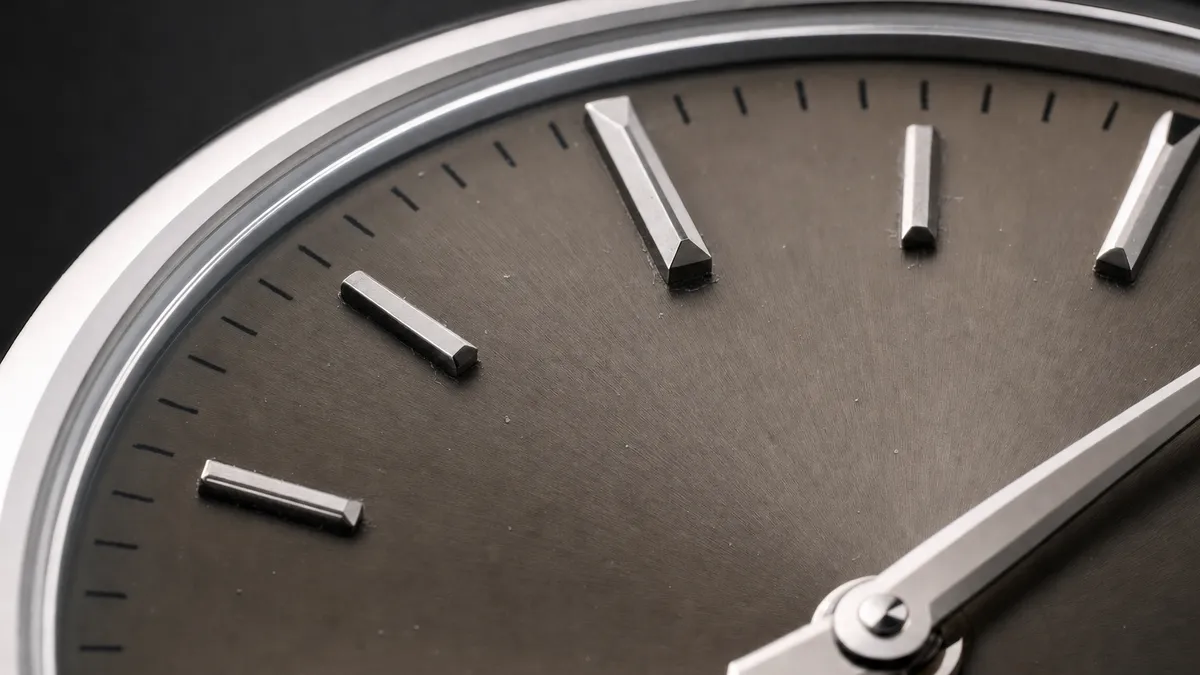 Replica
 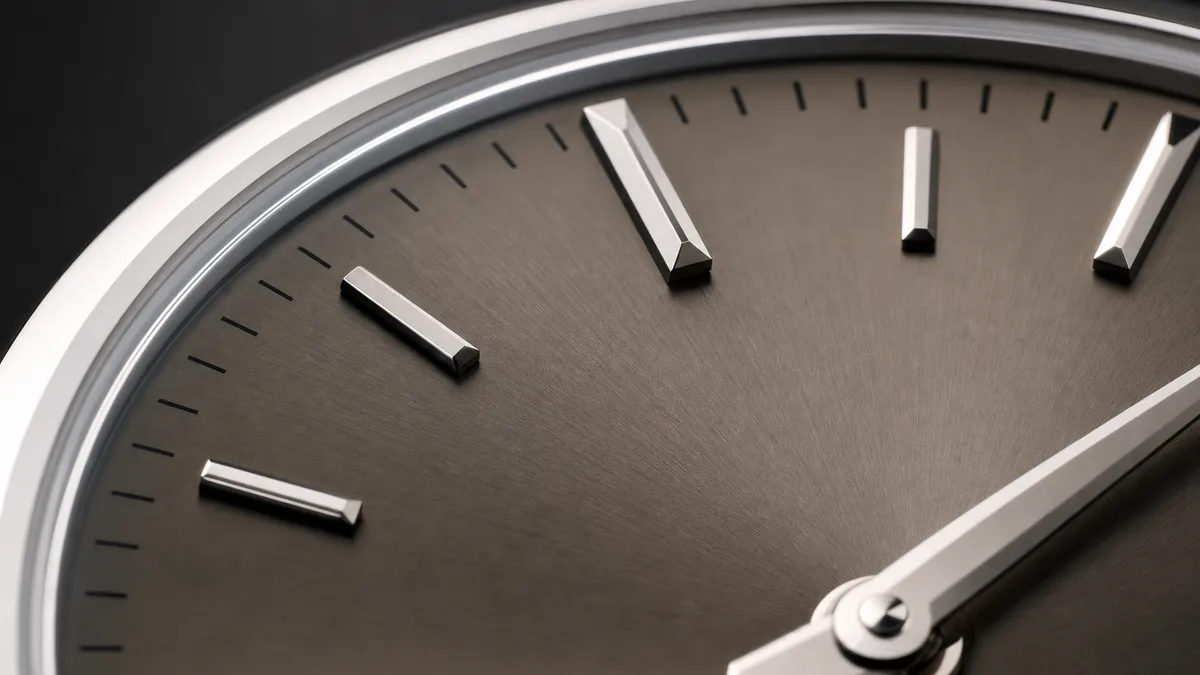 Authentic
 1. Dial: logo and indices
Authentic: On most lines the Omega logo and hour markers are applied metal elements with real depth and sharp, polished edges; the printed text is razor-sharp and everything is perfectly aligned.
Fake: A flat painted or “printed” logo instead of an applied one, blurry or misaligned lettering, crooked markers, or glue traces at their base.
2. Case-back engravings
Authentic: Clean, deep engraving that matches the model: the Seahorse (Hippocampus) on a Seamaster, moon-heritage wording on a Speedmaster; even lines and crisp type.
Fake: Shallow, faint, or “floating” engraving, a seahorse on a non-Seamaster, incorrect or smudged wording, and uneven letter spacing.
3. Helium valve and case
Authentic: The helium escape valve at 10 o’clock appears only on Seamaster divers (300M, Planet Ocean); the case is heavy, the edges are immaculately polished, and the Omega-signed crown screws down snugly on its threads.
Fake: A cosmetic valve on a model that shouldn’t have one — or a missing valve on a Seamaster diver; a lightweight case, soft “melted” edges, a wobbly crown, and threads that catch.
4. Dial texture and subdials
Authentic: Signature textures are executed cleanly: the vertical “teak” ribs on an Aqua Terra, the three chronograph subdials on a Speedmaster with hands aligned dead-on; lume applied in even plots.
Fake: Coarse or uneven texture, subdials that sit off-center, hands that miss their zero, and lume applied in blotches or looking weak.
5. Movement through the case back
Authentic: On refs with a sapphire case back the movement finishing is clean (Co-Axial on modern calibers): even bridges, a neatly engraved rotor, no grime or burrs.
Fake: A crude, bare movement under the glass, sloppy finishing, foreign parts, or a sapphire case back where the model should have a solid one.
6. Bracelet, clasp, and date window
Authentic: The bracelet and clasp carry an even Omega logo engraving with tight, play-free link assembly; the date window (where present) has crisp, aligned type.
Fake: Shallow or crooked engraving — or a sticker instead — a tinny lightweight bracelet, a date that sits off-center, and incorrect or blurry date type.
Popular Omega models
Model-by-model checks — what to look at on each:
Where to inspect
The key zones to photograph and check on this type of item — a schematic, not a product photo.
- 1Dial and printing
- 2Bezel and markings
- 3Crown
- 4Bracelet and links
- 5Serial and engraving
How to photograph your Omega for a check
Shoot in daylight, avoid glare, keep focus sharp. You need 5 angles:
- 1 Dial straight-on
- 2 Case back and engraving
- 3 Helium valve and case from the side
- 4 Subdials and texture close-up
- 5 Clasp, bracelet, and crown
How to read the result
The AI returns a verdict with a confidence score:
- 75–100% — Authentic: high confidence the item is genuine.
- 60–74% — Likely authentic: probably genuine with minor concerns.
- 40–59% — Uncertain: the photos are not conclusive — retake or add angles.
- 25–39% — Likely fake: several red flags.
- 0–24% — Fake: clear signs of a replica.
Check your Omega right now
Snap photos of your item and get an AI verdict with a confidence score in about a minute.
FAQ
Does every Omega have a helium valve?
No. The helium escape valve at 10 o’clock is a feature of professional Seamaster divers (300M, Planet Ocean). Classic Speedmasters, Constellations, and dress models shouldn’t have one, so a cosmetic valve on such a model is a red flag.
Does the Seahorse (Hippocampus) appear on any Omega?
No — the seahorse is the emblem of the Seamaster line, and you should expect it specifically on a Seamaster case back. Speedmasters carry moon-heritage wording, and other lines have their own engravings. A seahorse on a non-Seamaster is a reason to scrutinize the rest of the details.
Does a smooth seconds-hand sweep guarantee it’s authentic?
No. Mechanical Omegas sweep smoothly, and a quartz tick on a mechanical model is a warning sign — but good replicas also use mechanical calibers with a smooth sweep. Read the sweep together with the applied markers, the engravings, and the movement finishing.
What matters most to photograph for a check?
The dial straight-on (logo and markers close up), the case back with its engraving, the helium-valve area and case from the side, the subdials and texture, and the clasp with the crown. The AI catches most Omega replicas from these zones.